

Kenya’s SACCO Boom Faces a Generational Test

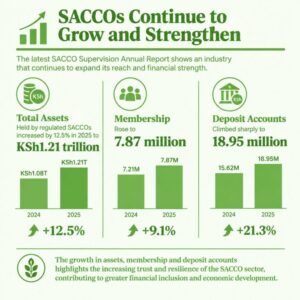
Kenya’s SACCO sector is growing. However, the more important question is whether it is becoming younger. The latest SACCO Supervision Annual Report shows an industry that continues to expand its reach and financial strength. Total assets held by regulated SACCOs increased by 12.5% in 2025 to KSh1.21 trillion, while membership rose to 7.87 million. The number of deposit accounts also climbed sharply to 18.95 million.
Behind these headline figures, however, lies a less straightforward picture of financial inclusion. A sector can grow rapidly in assets and membership while participation remains uneven across groups. This is particularly evident among young Kenyans.
The Authority’s SACCO Sub-Sector Financial Inclusion Report 2025, drawing on lessons from the 2024 FinAccess Household Survey, found that SACCO participation varies significantly by age. Adults aged 36 to 45 and 46 to 55 were the most frequent users, while those aged 18 to 25 recorded the lowest participation rates.
That finding matters because the younger population represents the next generation of SACCO members, borrowers, savers and investors. If participation is concentrated among older working-age adults, the sector will eventually need to address how to bring younger Kenyans into its financial ecosystem. The challenge is not necessarily that SACCOs are inaccessible. Rather, it raises questions about whether the traditional SACCO model is sufficiently aligned with how younger consumers access and use financial services.
Signs of Adapting Sector
The report shows a clear expansion of digital financial services. The number of approved digital financial products rose from 345 in 2024 to 407 in 2025, while the number of SACCOs offering such products increased from 236 to 267. Agency outlets also rose to 4,377 across 42 SACCOs.
More importantly, the financial inclusion analysis found that mobile banking, including USSD services and apps, accounted for 55% of SACCO service usage in 2024, up from 19.08% in 2021. The shift was particularly pronounced among younger and urban members, whereas older and rural members continued to rely more heavily on traditional channels.
This suggests that digitalisation could be one way for SACCOs to broaden their appeal. However, digital access alone does not automatically translate into membership. The question is whether SACCOs are using technology to rethink the member experience, or simply placing existing products on new platforms.
Importance of Distinction
For years, SACCO membership has been closely associated with formal employment, organised professions, agricultural activity and established community networks. The report notes that membership is highest among those with post-tertiary education and those in formal employment. This poses a potential structural challenge for younger Kenyans entering a labour market where employment patterns are shifting and formal employment is no longer the only route to earning an income.
SACCOs may therefore need to look beyond simply recruiting more members. The larger opportunity lies in designing products and membership models that reflect a younger, increasingly digital economy. The sector already plays a significant role in household finance. In 2025, regulated SACCOs disbursed KSh596.54 billion in loans across eight key sectors, including KSh157.20 billion for land and housing, KSh124.51 billion for education and KSh110.74 billion for agriculture.
That makes the question of youth participation more consequential. SACCOs are not marginal players in Kenya’s financial system. They are already financing some of the major economic decisions that households make.
The next phase of growth, therefore, cannot be measured solely by assets, loans or membership numbers. It will also be about the composition of that membership and whether younger Kenyans view SACCOs as relevant to their financial lives. The report provides a clear starting point: overall access is increasing, but participation remains uneven across age groups.
For SACCOs, the task ahead is to translate that insight into product innovation, digital convenience and broader pathways to membership. For policymakers, the issue is equally relevant to the wider financial inclusion agenda. Kenya’s SACCO movement has demonstrated it can grow. Its next test may be whether it can grow across generations. If the sector can close that generational gap, its growth story will become not only larger but also more representative of Kenya’s economy and workforce over time.