

Who Pays for Progress? Infrastructure, Land Rights, and the Hidden Costs of Kenya’s Mega-Projects

Direct foreign investors, project sponsors, and infrastructure syndicates view East Africa as a premier frontier for deploying industrial-scale, high-yield assets. Yet executing mega-infrastructure across emerging economies faces a critical off-balance-sheet exposure: the deep structural gap between state-level land allocation and local community land rights.
The ongoing legal standoff over the proposed US$16 billion (KSh 2.2 trillion) Dangote Oil Refinery on Land Reference No. 13061 in Lamu County serves as an operational case study. While macro-level state agreements guarantee site allocation and political backing, ground-level friction, manifested through court injunctions, customary land claims, and environmental litigation, poses significant legal, financial, and reputational risks to capital investment.
Case Analysis: L.R. No. 13061 and the Anatomy of Project Stalls
In late September 2026, ahead of the planned groundbreaking for a 700,000-barrel-per-day regional refinery, 133 residents of Chandavai and Hindi/Manda Magogoni filed an urgent petition before Justice Jane Onyango at the Malindi Environment and Land Court. The petitioners sought orders to halt development, alleging that heavy civil machinery and state agents entered their ancestral holdings without statutory notice, transparent valuation, or prior compensation.
The September 30, 2026, groundbreaking, led by President William Ruto alongside regional leaders, proceeded despite ongoing court proceedings, bringing political assurances into direct contact with local resistance:
- Political Warnings Against Sabotage: Speaking ahead of and during the Coast tour, President Ruto defended the KSh2.2 trillion project against critics, share brokers, and court petitions, saying: “There are people who think they can sabotage investment in this refinery… I want to tell them that they cannot deceive us all the time.”
- Public Participation & Equity Appeals: The President urged Kenyans to purchase shares in the project on the Nairobi Securities Exchange (NSE) once it is listed, framing the refinery as a public-private partnership. Meanwhile, political figures, including Kiharu MP Ndindi Nyoro and local Coast leaders, raised questions about state shareholding, community compensation, and guarantees of local employment.
- Executive Assurances on Land & Jobs: President Ruto assured residents that land matters would be handled lawfully and fairly, promising up to 60,000 direct and indirect jobs and peak construction wages of KSh 2 billion per month, while setting a strict 40-month completion target for Dangote Group.
The resulting interim court standoff highlights three primary structural exposures for project sponsors:
- The Absentee Title vs. Occupant Exposure: State agencies frequently structure land acquisition deals around paper titles held by historical speculators. When project teams attempt physical entry, they encounter generations of occupants who rely on customary tenure and constitutional protections under Article 63 and the Community Land Act (2016).
- Procedural Violations under the Land Act (2012): Under Article 40 of the Constitution and Sections 107–120 of the Land Act, compulsory acquisition requires a strict chain of custody: gazettement, notice to the direct occupier, public inquiry, fair market valuation, and prior payment before physical possession. Deploying civil machinery before completing these statutory milestones creates clear legal vulnerability to injunctive relief.
- Overlapping Jurisdictional Claims: Projects situated within complex development corridors face multi-layered administrative claims. When state actors assume prior compensation was settled while residents claim non-payment, the operating corporate entity bears the cost of operational delay.
Capital Allocation Dilemmas: Compensation Mechanics on Unregistered Community Land
From an investment committee perspective, “land acquisition” is often treated as a fixed CapEx line item settled with government counterparties. Traditional statutory compensation frameworks systematically fail to mitigate ground-level operational risk due to three actors:
- Non-Market Livelihood Valuation Deficits: Standard monetary models focus almost exclusively on registered real estate and physical structures. They systematically fail to account for the loss of shared, untitled natural capital, such as communal grazing lands, artisanal fishing corridors, mangrove ecosystems, and indigenous forests, that sustain local informal economies.
- Distorted Market Rate Assessments: Official assessments routinely rely on historical state valuation rates that do not reflect replacement costs, localised inflation, or the speculative appreciation triggered by the project’s own announcement. Displaced populations are left unable to secure equivalent alternative holdings.
- Cash Payout Delays: When state disbursement channels face administrative backlogs, affected populations are prevented from using their land for years before receiving funds, leading to local labour disruptions and legal challenges.
Quantification of Hidden Costs: Feasibility Modelling vs. Realised Friction
Evaluating mega-developments solely on direct engineering, procurement, and construction (EPC) costs obscures significant off-balance-sheet exposures that directly affect asset yield and debt service:
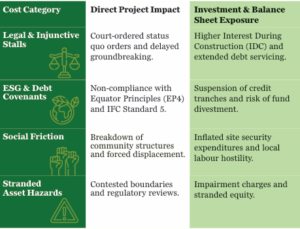
Operational Playbook: Mitigating Land & Community Exposure
To protect capital deployment and ensure sustainable asset operations across emerging markets, capital allocators must embed a three-part risk mitigation model within early-stage governance:
- Mandate Pre-FID Independent Tenure Audits: Conduct ground-truthing studies before Final Investment Decision (FID) to verify actual land occupancy and customary use alongside official registries.
- Operationalise Free, Prior, and Informed Consent (FPIC): Integrate FPIC mechanisms into the early engineering and design phases to establish transparent community engagement and benefit-sharing frameworks from the outset.
- Internalise Comprehensive Livelihood Restoration Funds: Incorporate full socio-ecological impact evaluations and dedicated livelihood restoration budgets directly into primary project CapEx.