

Dry Weather Puts Kenya’s Food Security Under Pressure
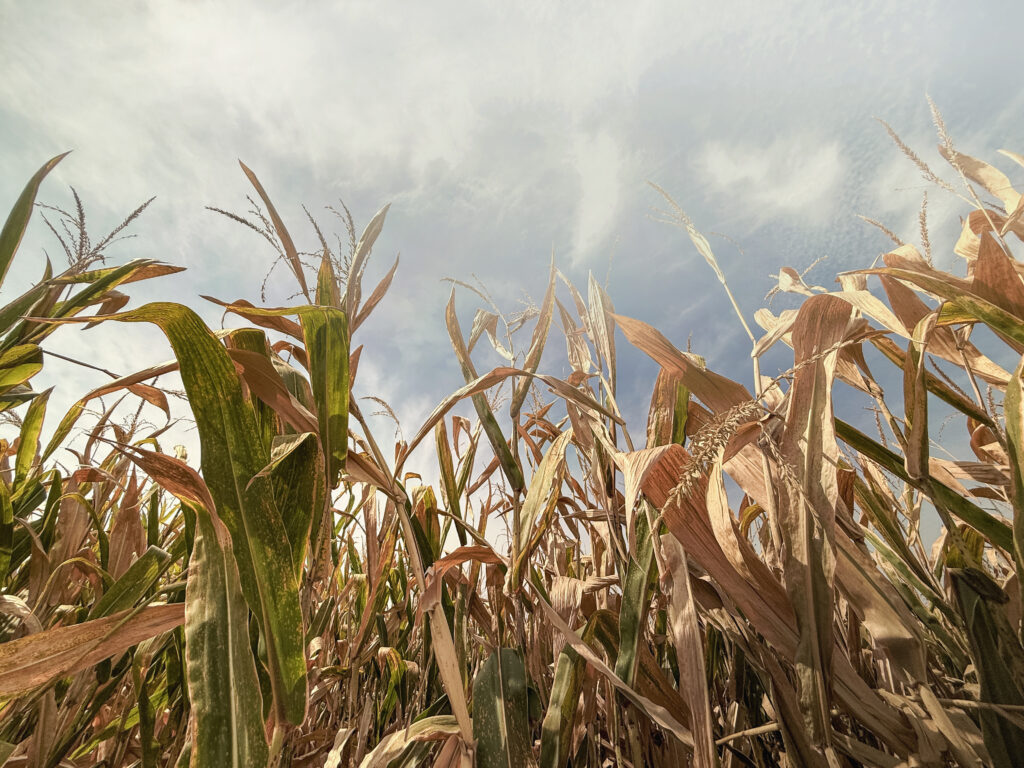
Kenya is heading into the 2026/27 agricultural marketing year facing a major setback in producing two of its most important grains after an unusually severe mid-year dry spell damaged crops across key agricultural regions. A new report by the U.S. Department of Agriculture’s Foreign Agricultural Service (FAS) in Nairobi has sharply downgraded its forecasts for maize and wheat production, projecting that Kenya will need much larger imports to offset the shortfall. The report estimates that maize production will fall to 2.2 million metric tonnes, while wheat output is expected to decline to 130,000 tonnes.
Depleted maize stocks and the prospect of further abnormal weather compound the situation. While rice production is expected to remain comparatively stable because of irrigation, the broader agricultural outlook points to a food system increasingly exposed to extreme swings between drought and excessive rainfall.
Blow to the Maize Harvest
Maize has borne the brunt of the weather shock. FAS Nairobi has reduced its 2026/27 maize production forecast by 51 per cent, from an initial projection of 4.5 million tonnes to 2.2 million tonnes. The report attributes the decline to an extended dry spell that affected western Kenya from early June through late July 2026. The dry period came after the onset of rains and coincided with critical stages of crop development. The resulting conditions caused widespread wilting, stunting and crop failure. Rainfall levels across much of Kenya’s grain-producing regions were among the lowest recorded in decades. Although rainfall returned towards the end of July, it was not in time to prevent the widespread loss.
Field observations and satellite assessments cited by the report indicate particularly severe damage across the North Rift and Western regions. In parts of these areas, close to half of the planted crop is estimated to have been wiped out. Even surviving fields are expected to see yield reductions of up to 35 per cent. The losses are concentrated in major surplus-producing counties, including Uasin Gishu, Trans Nzoia and Nakuru. This is significant because these areas normally contribute substantially to the country’s domestic maize supply. The deterioration has occurred despite an expansion in maize planting. The report notes that farmers had increased planted area following the previous season’s performance and government support, but the subsequent weather shock undermined the expected gains. FAS now estimates harvested maize area at 1.5 million hectares, down from the earlier projection of 1.8 million hectares.
Record Maize Imports on the Horizon
The production deficit comes against a backdrop of continued strong domestic demand. FAS has retained its consumption forecast at 4.5 million tonnes because demand for white maize, Kenya’s principal staple, is considered relatively unyielding. This means that the production shock cannot easily be absorbed through reduced consumption. Instead, Kenya is expected to rely more on imports.
The report projects maize imports of 2.3 million tonnes for the 2026/27 marketing year, a historic level. The government has already announced its intention to import maize, although the report notes that it had not yet identified specific supply sources at the time of publication. The challenge is that Kenya’s traditional regional suppliers are also facing agricultural pressures. Eastern Uganda has experienced adverse weather, while Tanzania is expected to have an exportable surplus of only about 800,000 tonnes. Zambia presents another potential source after recording a strong 2026/27 harvest, with an estimated exportable surplus of about 1.47 million tonnes. However, the report cautions that future exports could be affected by the anticipated El Niño conditions and lower production expectations for the subsequent cycle.
Kenya can also look to major global producers such as Argentina, Brazil, South Africa, Ukraine and the United States. Yet access to these markets faces several constraints, including tariffs, logistical challenges, and Kenya’s restrictions on genetically modified products. The pressure extends beyond household food consumption. Kenya’s animal-feed industry already faces recurring maize deficits, while millers could face serious operational difficulties if the projected imports do not materialise. The report says the feed sector may increasingly need to consider alternatives such as lower-cost, non-genetically modified sorghum.
Wheat Harvest Cut by More Than Half
The weather shock has also significantly altered Kenya’s wheat outlook. FAS has reduced its 2026/27 wheat production forecast from 280,000 tonnes to 130,000 tonnes. The decline is attributed primarily to prolonged dryness across major wheat-producing areas in the Rift Valley. The harvest area is now projected at 70,000 hectares, down from an earlier estimate of 100,000 hectares. Average yields are expected to fall to 1.8 tonnes per hectare, compared with the original projection of 2.8 tonnes. The impact may not be limited to the quantity of wheat harvested. The report cites industry expectations of declining crop quality, with prolonged drought likely to produce low test weights and smaller, stunted grains. This could create additional challenges for milling companies even as they increase reliance on imports.
Kenya’s structural dependence on imported wheat provides some protection against a domestic production collapse. Local production has historically supplied less than 15 per cent of domestic demand, meaning millers already depend heavily on international markets. FAS therefore expects wheat imports of about 2.6 million tonnes in 2026/27. Traditional sources include the Black Sea region, Argentina and Australia. The report also notes a recent change affecting U.S. wheat, which must now undergo destination inspection at the port of entry after Kenya terminated the previous pre-export inspection arrangement in the United States.
Rice Provides a Different Picture
Rice presents a contrasting picture. Unlike maize and wheat, which are predominantly rain-fed, much of Kenya’s rice is cultivated under managed irrigation schemes. FAS has therefore maintained its 2026/27 production forecast at 225,000 tonnes from a harvested area of 55,000 hectares, with an average yield of 6.2 tonnes per hectare. The Mwea Irrigation Scheme in Central Kenya remains particularly important to this production system. Effective water management has helped shield rice production from the severe rainfall deficit affecting rain-fed crops.
However, irrigation has not made rice completely immune to the drought. Parts of the Mwea scheme have experienced water shortages because Thiba Dam is depleted. Earlier drought conditions led to water rationing and localised production disruptions. A new irrigation canal project, expected to be completed in August 2026, was projected to bring an additional 10,000 acres under cultivation and help offset some localised production losses. Even with relatively stable domestic production, Kenya will continue to rely heavily on imported rice. FAS projects domestic consumption at 970,000 tonnes and imports at 750,000 tonnes. Demand has been supported by changing dietary habits, urbanisation, and urban consumers’ increasing preference for convenient, quick-to-prepare foods.
Imports are expected to come mainly from traditional Asian suppliers, including Pakistan, India and Thailand, with traders expected to take advantage of a duty-free import window running until November 30, 2026.
From Drought to Excessive Rainfall
The report’s most significant warning is that normal weather may not return after the current dry spell. FAS expects abnormal weather conditions to continue through the remainder of 2026 and into 2027, driven by an emerging El Niño event occurring alongside a strongly positive Indian Ocean Dipole. The report estimates an 80 to 82 per cent probability of the region shifting into an intense, hyper-wet season by October. Kenyan weather experts cited in the report have warned that the configuration resembles the conditions associated with the catastrophic East African floods of 1997.
Such a rapid transition could create another set of agricultural problems. While heavy rainfall would replenish depleted reservoirs and water sources, intense downpours could trigger flash floods, wash away crops and increase post-harvest losses where farmers lack sufficient drying facilities. The anticipated impact is expected to be particularly significant in the short-rain agricultural regions of Eastern and Central Kenya.
A Test for Kenya’s Food System
The report ultimately presents a food system facing several interconnected pressures: falling domestic production, depleted stocks, persistent consumption requirements, and greater dependence on imports. The maize situation is particularly acute because domestic consumption is expected to remain at 4.5 million tonnes even as production falls to 2.2 million tonnes. Wheat faces a similar production shock, although Kenya’s established dependence on international wheat markets provides a mechanism for filling the gap. Rice shows irrigation’s potential to cushion agricultural production from rainfall variability, but the challenges at Mwea also show that irrigation infrastructure depends on adequate, well-managed water resources.
Kenya’s immediate challenge will be securing sufficient supplies while navigating constraints around regional production, global availability, tariffs, import requirements, and non-GM sourcing. The longer-term challenge is more structural. The sharp shift from severe dryness to the possibility of intense rainfall shows how difficult it is to plan agricultural production around increasingly volatile weather conditions.
In conclusion…
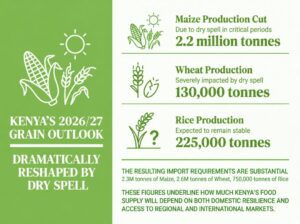
Kenya’s 2026/27 grain outlook has been dramatically reshaped by a dry spell that struck key agricultural areas during critical crop-development periods. Maize production has been cut to 2.2 million tonnes, wheat to 130,000 tonnes, while rice production is expected to remain at 225,000 tonnes. The resulting import requirements are substantial: 2.3 million tonnes of maize, 2.6 million tonnes of wheat, and 750,000 tonnes of rice. These figures underline how much Kenya’s food supply will depend on both domestic resilience and access to regional and international markets. At the same time, the prospect of a rapid transition from drought to intense rainfall adds another layer of uncertainty. The same agricultural system that has just absorbed widespread crop losses could soon face flooding, crop destruction, and post-harvest spoilage.
The experience therefore goes beyond one poor harvest. It highlights the growing importance of irrigation, water management, strategic reserves, diversified sourcing and agricultural resilience in protecting Kenya’s food supply. For 2026 and into 2027, the country’s ability to navigate both the immediate grain deficit and the next phase of weather volatility will be central to its food system’s stability.