

Kenya’s G7 Debut: A Voice for Africa as Western Powers Compete for the Continent
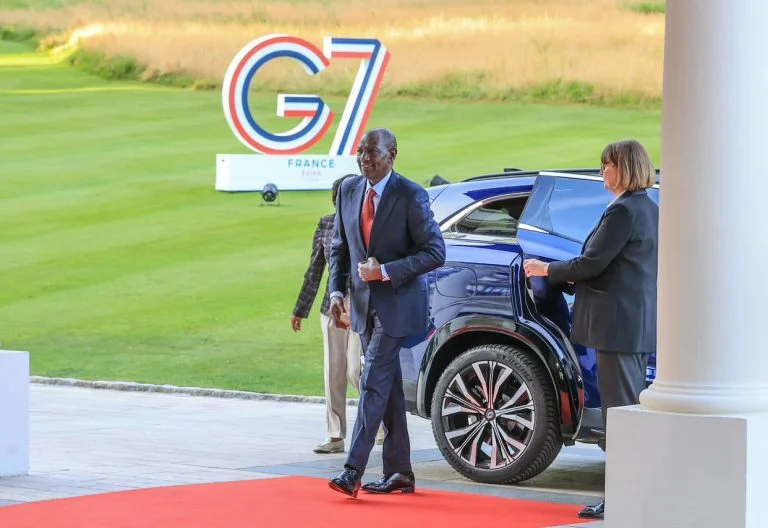
Kenya’s participation at the G7 Summit in France highlighted the delicate balance between international opportunity and domestic political risk, particularly as its presence came under the spotlight following South Africa’s exclusion amid reported United States (U.S.) pressure, even though French officials had denied excluding South Africa due to pressure from Washington.
The participation followed the country’s co-hosting of the Africa Forward Summit with France on 11th and 12th May in Nairobi, the first time the event was held in a non-Francophone country. France was seen as pitching a new model of partnership with African countries, even as it continues to withdraw its military from West Africa, widely considered a sign of declining influence on the continent.
Kenya was among the guest countries, which included India, South Korea, and Brazil, and President William Ruto was representing the country at a time when the continent is pushing for a stronger voice in global decision-making.
South Africa, a regular guest at past G7 Summits, had stated that the U.S. had threatened to boycott the summit if South Africa was invited. U.S. President Donald Trump has criticised South Africa’s foreign policy and domestic race laws, boycotted last year’s G20 Summit in Johannesburg, and excluded South Africa from G20 meetings this year.
The G7, or Group of Seven, is made up of the U.S., Britain, Canada, France, Germany, Italy, and Japan. These countries are among the world’s wealthiest and largest democracies. They meet every year to discuss global economic stability, security, trade, climate change and emerging challenges such as artificial intelligence (AI).
The group traces its origins to the 1973 oil crisis, when finance ministers from the U.S., Britain, France, Japan and what was then West Germany began meeting informally as the “Big Five” to coordinate responses to global economic instability.
Although the G7 does not enact binding laws, its decisions carry weight because its members account for a large share of global GDP and influence international institutions such as the World Bank Group and the International Monetary Fund (IMF).
During the Summit held in the Alpine town of Évian-les-Bains, near Lake Geneva, President Ruto pitched Africa in a positive light, calling for world leaders to see Africa as a partner, not a beggar, in renewed global engagement.
President Ruto challenged world leaders to rethink their perception of African countries, stating that the continent has vast potential and needs genuine support to flourish.
The President said lending institutions such as the World Bank Group, the IMF, and the International Finance Corporation (IFC), among others, were being unfair to African countries by exaggerating risks on the continent, thereby undermining opportunities and potential for growth.
Of late, debt reform has been part of President Ruto’s speeches when engaging with leaders of Western countries. He has been arguing that Africa is unfairly judged on risk and is usually charged high interest rates to secure credit. He says the impact is that African countries are perennially paying loans instead of utilising the funds for development.
President Ruto, while speaking during the G7+ Working Session on Reviving Balanced and Shared Growth for All, said Africa is no longer interested in partnerships that only benefit others while leaving little value on the continent. Instead, he said, a new era of cooperation is focused on industrialisation, manufacturing, job creation, and shared prosperity.
He argued that Africa is becoming increasingly important to the global economy, noting that six of the world’s fastest-growing economies are in Africa. President Ruto also cited the continent’s vast reserves of critical minerals that are powering the global shift towards electric vehicles, clean energy, digital infrastructure, AI, and advanced manufacturing.
His remarks came at a time when global powers are increasingly competing for access to Africa’s strategic minerals and rapidly expanding consumer market.
The country’s G7 participation was an opportunity to ensure that summit debates on global imbalances did not neglect the shared responsibility to emerging economies. Another challenging objective was to ensure that stricter European Union (EU) trade measures did not disincentivise Chinese investments in African export industries. Kenya was also expected to leverage its commitment to Ebola quarantine to secure U.S. concessions, including progress on a trade agreement first proposed during President Trump’s first term.