

Beyond 2030: Kenya Must Now Chart a New Development Path
The goal of making Kenya an upper-middle-income economy by 2030 remains far from being realised. However, the shortcomings should not be interpreted as a failure of Vision 2030 but as an opportunity for the country to evaluate its progress and prepare for the next phase of development.
While President William Ruto acknowledged in his special national address on July 30 that the country is unlikely to attain this goal, he argued that this is an opportune time for the country to take stock of what has been achieved, identify where implementation fell short, and develop a new long-term strategy that reflects changing economic realities and national priorities.
In his view, Kenya has a second chance to position itself at the centre of this shift, provided it learns from the opportunities missed in previous waves of global industrialisation. Rather than producing another government policy document, President Ruto called for a national conversation to translate constitutional aspirations into measurable development outcomes and to provide a long-term framework for shared prosperity.
The speech came during a week of heightened political activity, which began with the highly anticipated Western Kenya political tour by Nairobi Senator Edwin Sifuna. Against this backdrop, the President used his Thursday evening address to invite Kenyans to join him on what can be described as a national journey towards transforming the country into a first-world economy.
The address also came just days after Kisumu County Governor Prof Peter Anyang’ Nyong’o led a team of independent economic scholars who prepared reflections and strategic proposals for the country’s development beyond 2030. The report, presented to the President, recommended the formulation of a new national development vision to achieve inclusive prosperity and position the country as a globally competitive and developed nation.
The timing of the President’s address suggests that the debate over Kenya’s post-2030 development agenda has already begun. Even though political temperatures are rising, with a focus on electoral alignments ahead of next year’s general election, the President appears keen to advance the national discourse towards a long-term agenda.
Unlike Vision 2030, which was largely driven by government and technical experts, President Ruto is envisioning a citizen-owned blueprint shaped by broad-based organisations and ordinary citizens.
This will present an opportunity to build a national consensus on development that transcends electoral cycles and successive governments, while positioning Kenya so that it can benefit from the continent’s next wave of economic transformation.
Nevertheless, Kenya’s success beyond 2030 will depend not on producing another ambitious policy blueprint, but on whether the country can build the institutions, political consensus and implementation discipline needed to translate long-term aspirations into measurable development outcomes.
Vision 2030
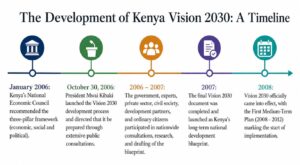
The Vision 2030 blueprint was developed between 2006 and 2007, and its implementation began in 2008.
The National Economic Council studied countries that had successfully transformed their economies within 20 to 30 years, with particular reference to the newly industrialising countries of Southeast Asia. They wanted to understand the policies, reforms and strategies that had enabled them to move from poverty to broad-based prosperity and adapt those lessons to Kenya’s own settings.
They succeeded in learning from these countries and adapted these best practices into the vision, but the country has only partially realised the aspirations of the blueprint.
Even though Vision 2030 has fundamentally changed Kenya’s development planning and policy direction, the blueprint is yet to deliver the full economic transformation achieved by the countries that inspired it.