

Vision 2030 Revisited: Hits, Misses and the Transition to Kenya’s Next Development Compact
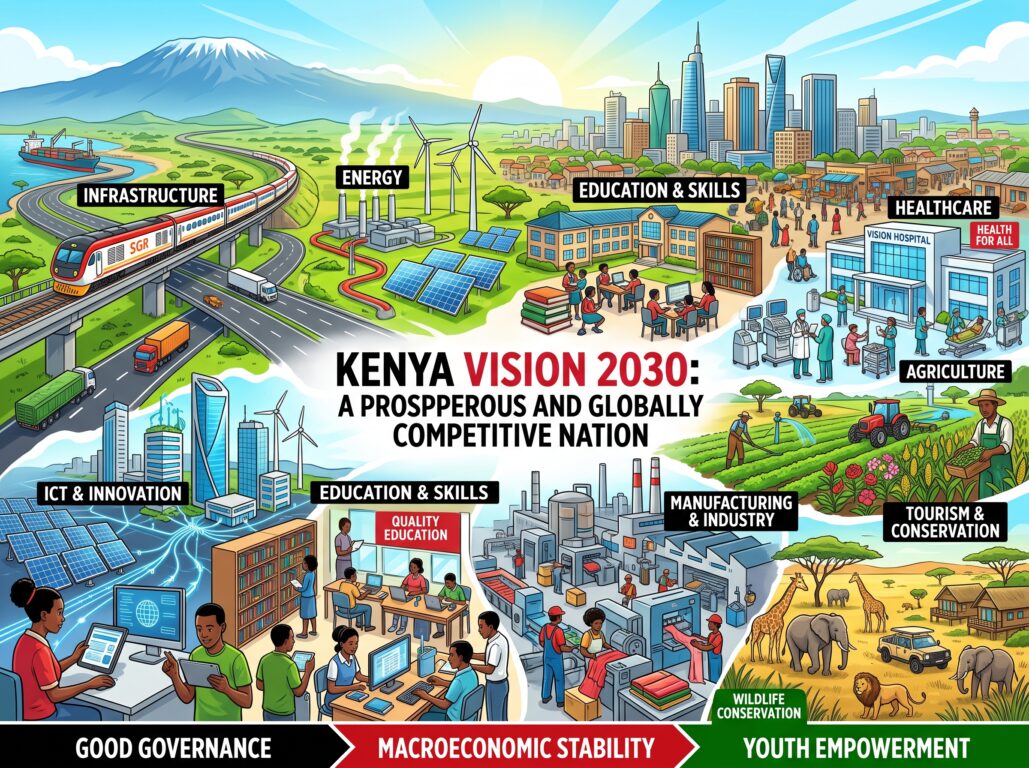
Nearly two decades after its launch, Vision 2030 has reached an inflection point. As President William Ruto initiates a national conversation on Kenya’s next long-term development framework, the country has an opportunity to undertake an equally important exercise: evaluating whether Vision 2030 delivered on its promise of transforming Kenya into “a globally competitive and prosperous nation with a high quality of life”.
The emerging conversation should not be viewed as replacing Vision 2030. Rather, it is an opportunity to understand what worked, what fell short, and how Kenya can strengthen the institutional foundations necessary to achieve sustained economic transformation. The Strategic Guidelines for Long-Term National Transformation and the President’s address suggest that the next phase of development will be less about identifying new priorities and more about ensuring policy continuity, institutional resilience and long-term execution.
Vision 2030’s Greatest Achievement Was Institutional
While Vision 2030 is often associated with flagship infrastructure projects, its most enduring contribution was changing how Kenya plans for development.
For the first time, Kenya adopted a long-term national framework that extended beyond electoral cycles. Through successive Medium-Term Plans (MTPs), the strategy introduced structured planning, results-based management and clearer alignment between public investment, development partner financing and private sector participation. It also provided investors with greater policy predictability by signalling Government’s long-term priorities.
Perhaps its greatest legacy was embedding long-term planning into Kenya’s governance architecture. Successive administrations retained Vision 2030 as the country’s overarching development framework, demonstrating its value as a national rather than purely political strategy.
Kenya’s Long-Term Development Journey
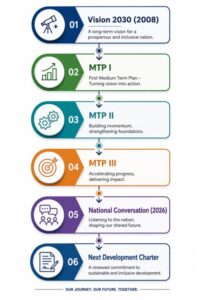
Hits: Where Vision 2030 Delivered
Measured against its sectoral objectives, Vision 2030 recorded significant progress across several areas.
Kenya substantially expanded transport, energy and digital infrastructure, improving connectivity and strengthening the foundations for future economic growth. The country also emerged as one of Africa’s leading digital economies through rapid expansion of mobile financial services, digital innovation and ICT adoption. Renewable energy capacity increased significantly, positioning Kenya among global leaders in clean electricity generation, while financial inclusion expanded dramatically through mobile money and digital financial services.
These investments enhanced Kenya’s attractiveness as a regional business and investment hub and contributed to stronger macroeconomic resilience.
However, these successes were uneven across sectors.
Vision 2030 Performance Scorecard
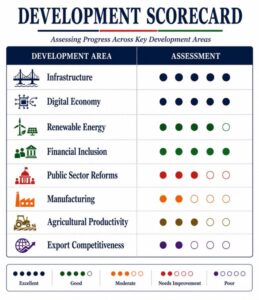
Overall Assessment: Kenya modernised faster than it industrialised.
The Misses: Growth Without Structural Transformation
Despite notable progress, Vision 2030 fell short of its defining ambition—transforming Kenya into an upper-middle-income, industrialised economy by 2030.
Economic growth remained positive but insufficient to fundamentally alter the country’s productive structure. Manufacturing failed to become the engine of growth envisioned under Vision 2030, while export diversification remained limited and agriculture continued to experience uneven productivity gains. Youth unemployment, informality and regional inequalities also persisted despite sustained investment.
This reflects an important distinction between economic growth and economic transformation.
Kenya expanded its economy, modernised infrastructure and strengthened the services sector. Yet the economy remained heavily dependent on consumption and services rather than higher-productivity manufacturing and value-added exports that have historically driven transformation in countries such as South Korea, Vietnam and China.
Vision 2030 therefore succeeded in modernising Kenya but was less successful in fundamentally restructuring its economy.
The Missing Ingredient: Policy Continuity
Perhaps the most important lesson emerging from Vision 2030 is that Kenya has not lacked ambitious development strategies, it has lacked sustained implementation.
Although Vision 2030 remained the country’s official development blueprint, successive administrations increasingly introduced parallel flagship programmes, including the Big Four Agenda and the Bottom-Up Economic Transformation Agenda (BETA). While many of these initiatives complemented Vision 2030, shifting priorities often fragmented implementation, redirected resources and weakened long-term policy continuity.
The Strategic Guidelines correctly identify this institutional inconsistency as Kenya’s principal development challenge. Unlike many high-performing economies, where long-term development priorities remain largely constant despite political change, Kenya has frequently recalibrated priorities with each electoral cycle.
Kenya’s Development Challenge
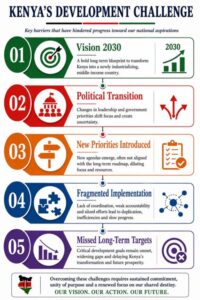
The lesson is clear: development outcomes depend not only on good policy, but on institutions capable of sustaining that policy over time.
Why the New Development Charter Matters
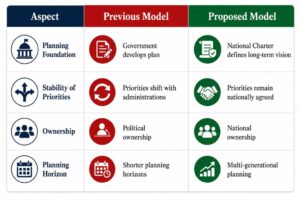
The proposed National Development Charter should therefore be understood as a governance reform rather than a wholesale policy shift.
Notably, the proposed priorities, agricultural transformation, export-oriented manufacturing and technology-driven growth, remain largely unchanged from Vision 2030. The real innovation lies in strengthening the institutions responsible for implementation and creating mechanisms that preserve continuity across successive governments.
If successfully implemented, the Charter could fundamentally reshape Kenya’s development model by reducing policy uncertainty, strengthening institutional coordination and providing investors with greater confidence that national priorities will endure beyond electoral cycles.
From Government Plans to a National Development Charter
Conclusion
Vision 2030 should neither be characterised as a failure nor viewed as a complete success. It successfully transformed Kenya’s planning culture, modernised critical infrastructure and accelerated the country’s emergence as a leading digital economy. However, it fell short of delivering the structural economic transformation necessary to achieve its upper-middle-income ambitions.
As Kenya looks beyond 2030, the central challenge is no longer identifying the right development priorities. Those priorities have remained remarkably consistent for nearly two decades. The greater challenge is creating institutions capable of implementing them consistently, regardless of changes in political leadership.
Ultimately, the success of Kenya’s next development charter will be measured not by the ambition of its vision, but by its ability to achieve what Vision 2030 could not: transforming long-term planning into sustained, cross-generational economic transformation.