

Who Checks the Inspectors? New Bill Seeks to Tighten Oversight of Public Service Vehicle Safety

The National Transport and Safety Authority (Amendment) Bill, 2026, proposes introducing a legal framework to regulate public service vehicle (PSV) conformity assessors, the professionals responsible for verifying that bus and matatu bodies meet approved safety and technical standards before they carry passengers.
Although the Bill is relatively short, its implications could be significant. By placing conformity assessors under the direct oversight of the National Transport and Safety Authority (NTSA), the proposed law aims to close a regulatory gap that lawmakers say has led to conflicts of interest in the public transport sector.
Rather than introducing new inspection requirements for PSV operators, the Bill focuses on strengthening the credibility and independence of those responsible for certifying vehicle safety.
Closing a Regulatory Gap
At the heart of the Bill is a simple question: Who should certify that a public service vehicle has been built to the required standard?
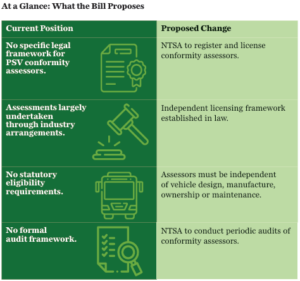
According to the Memorandum of Objects and Reasons, there is currently no specific legal framework governing PSV conformity assessors. Instead, assessments have largely been carried out by the Kenya Association of Bus Manufacturers, whose membership comprises bus owners and manufacturers.
The Bill argues that this arrangement creates a potential for conflicts of interest, as organisations involved in designing, manufacturing or owning public service vehicles may also influence the assessment process. The proposed amendments seek to separate those roles. Under the Bill, conformity assessors would be registered and licensed directly by NTSA, establishing a formal regulatory framework where none currently exists.
What Is Changing?
The Bill introduces three key amendments to the National Transport and Safety Authority Act.
First, it formally defines “conformity assessment” as the evaluation used to determine whether a public service vehicle meets prescribed technical requirements. It also introduces the definition of a “conformity assessor”, recognising the role in law for the first time.
Second, it gives NTSA an explicit mandate to register and license conformity assessors, making the Authority responsible for determining who is qualified to undertake these assessments.
Third, it establishes a licensing framework that requires assessors to demonstrate independence from the very activities they inspect.
That means an assessor cannot be involved in designing, manufacturing, supplying, installing, owning or maintaining the vehicle under assessment. Nor can they be linked to another person engaged in those activities. The objective is straightforward: to strengthen the impartiality of the certification process.
A New Role for NTSA
The proposed law also expands NTSA’s oversight responsibilities. Beyond licensing conformity assessors, the Authority would be required to develop the criteria for conformity assessments, designate assessors every three years, and conduct periodic audits to ensure they continue to comply with the law. Licensed conformity assessors would also be required to submit technical assessment reports to NTSA after completing inspections.
Taken together, these measures shift conformity assessment from a largely industry-managed process towards one subject to direct regulatory oversight. For NTSA, that represents a broader supervisory role. For assessors, it introduces clearer accountability.
Why It Matters
Although the Bill focuses on conformity assessors rather than PSV operators, its effects could extend across the public transport sector. Vehicle body construction is critical to passenger safety. Independent verification that vehicles comply with approved standards helps reduce the risk of poorly constructed or modified buses entering service.
The proposed framework may also enhance confidence in the inspection process by reducing perceived conflicts of interest among manufacturers, operators and assessors. For transport operators and body builders, however, the reforms could introduce additional compliance requirements as the industry adapts to a more formal licensing and oversight framework. Over time, increased regulatory scrutiny may affect project timelines, certification processes and documentation requirements.
Looking Ahead
The National Transport and Safety Authority (Amendment) Bill, 2026, is not a sweeping overhaul of Kenya’s transport laws. Instead, it addresses a specific, important gap in the country’s road safety framework.
By regulating those responsible for certifying public service vehicles, lawmakers hope to strengthen the integrity of a process that ultimately affects every commuter who boards a bus or matatu.
Whether the Bill delivers that outcome will depend not only on licensing assessors but also on how effectively the new framework is implemented and enforced. Road safety begins long before a vehicle leaves the terminal. It begins with confidence that the people certifying it are as independent as the standards they are expected to uphold.