

Bank Interest Rates: Who Should Hold the Approval Power?
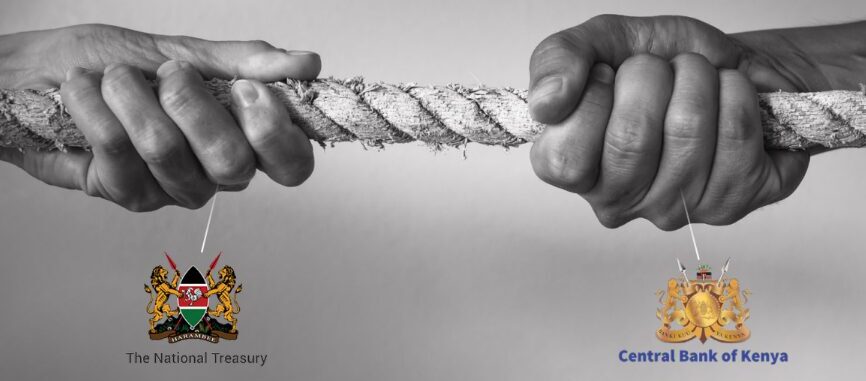
The CBK-Treasury Standoff
If you have a bank loan in Kenya, you might assume your bank can raise your interest rate whenever the Central Bank of Kenya (CBK) raises its benchmark rate. For years, banks assumed the same. But a law that had sat quietly in the background, Section 44 of the Banking Act, says something different: no bank may raise its rates or charges without first obtaining approval from the Cabinet Secretary for the National Treasury. That single rule has put two of Kenya’s most powerful financial institutions, Treasury and CBK, on opposite sides of the same question, a fight that resurfaced at a major banking conference in Diani this July.
According to the Courts
The dispute stems from a long-running case between Stanbic Bank and Santowels Limited. In June 2024, the Supreme Court ruled that Stanbic had overcharged Santowels by raising interest rates without Treasury approval and ordered the bank to refund the client over Sh10 million. The reasoning was straightforward: Section 44 provides that no institution can increase its “rate of banking or other charges” without the Treasury Cabinet Secretary’s sign-off, and the court held that loan interest rates fall within that category. In April 2025, the Supreme Court went further, rejecting Stanbic’s request to transfer power over banking rates to the CBK Governor, thereby confirming that the Treasury Cabinet Secretary retains that authority. Then, in December 2025, the High Court dismissed a separate case brought by the Kenya Bankers Association (KBA) seeking to have Section 44 struck out entirely. The court held that the law does not interfere with CBK’s constitutional role: CBK still controls monetary policy tools such as the Central Bank Rate, but the price a bank charges a customer is a commercial decision, and such decisions can be regulated to protect consumers. So, according to the courts, Treasury approval is required before banks raise rates.
CBK has not fully accepted this. At the July 2026 banking conference in Diani, CBK Governor Kamau Thugge told bankers that once CBK changes its Central Bank Rate, banks should pass the change on to customers immediately, without waiting for Treasury approval. This contradicts what the courts have ruled and leaves banks caught between two conflicting instructions from two different authorities.

KBA’s Defence and the Risk of Being Caught Between Two Regulators
The Kenya Bankers Association’s case against Section 44 was grounded in Article 231 of the Constitution, which safeguards CBK’s independence in setting monetary policy. KBA argued that requiring banks to obtain Treasury’s approval before adjusting rates constitutes political interference in what should be an independent, market-based process. The courts rejected this argument in both the original Stanbic case and the December 2025 case, ruling that Section 44 is intended to protect bank customers from sudden, unexplained rate increases, not to control CBK’s monetary policy.
This leaves banks with a practical dilemma. Raising rates as soon as CBK moves its benchmark, without Treasury’s approval, risks a lawsuit and a refund order, exactly what happened to Stanbic. Waiting for Treasury’s approval instead risks falling behind CBK’s expectations. Either way, the bank bears a risk it did not create alone. This is a common problem whenever a business must satisfy two regulators whose instructions do not align: the business absorbs the cost through legal risk, delays, or reputational damage, even though it did nothing wrong on its own.
It also raises a fair comparison. KRA collects taxes on behalf of Treasury; it enforces tax policy but does not set it. Based on how the courts have read Section 44, CBK’s role in approving day-to-day rate changes looks similar: CBK can move its own benchmark rate and shape the wider monetary environment, but the final say on whether banks may pass rate increases to customers still rests with Treasury, a narrower role than CBK’s public position suggests.
Outcomes from Diani Conference
The 23rd East African Banking School (EABS) Conference was held from 13 to 17 July 2026 in Diani, Kwale County. It was organised by the Kenya Bankers Association Institute, in collaboration with banking institutes from Uganda and Tanzania. Its official theme focused on credit risk in a digital age, with regulators and bank leaders discussing how banks should rely less on collateral and use artificial intelligence and alternative data to lend more responsibly. However, Thugge’s comments on rate approval, made at the same conference, reopened the long-standing, unresolved debate over who actually controls bank rates.
The clearest lesson from Diani is that Kenya’s banking sector is trying to modernise its lending models while still lacking a settled, agreed answer to a much more basic question. A workable way forward would be for Treasury and CBK to issue a single, joint, and clearly written framework for approving and communicating rate changes, rather than leaving banks to guess which authority to follow. Any Treasury approval process should also be fast and predictable, so it does not block CBK’s monetary policy from reaching customers in a reasonable time.
Conclusion
Kenya’s banks are not resisting regulation; they are simply asking which regulator’s instructions they must follow. Until Treasury and CBK agree on a clear framework, ideally backed by a change in the law rather than more court cases, banks will continue to bear the risk of that disagreement, with individual banks’ reputations on the line, and customers will continue to face uncertainty about how and when their loan rates can change.