

Protectionism and the EAC Common Market: Who Gets to Trade?

In recent weeks, Kenya’s retail landscape has undergone a significant policy pivot. Triggered by President William Ruto’s directive addressing micro-trader grievances in urban commercial centres, what began as an order targeting non-national hawkers and small-scale merchants has evolved into a complex regulatory and diplomatic dilemma. Following the initial market friction, Cabinet Secretary Lee Kinyanjui introduced a 90-day regularisation window under the Ministry of Investments, Trade and Industry, offering foreign micro-entrepreneurs a structured path towards formal compliance while clarifying work-visa requirements.
Beneath this administrative compromise lies a fundamental tension in East African political economy: the clash between domestic pressure, amplified by informal-sector agitation in hubs such as Gikomba and Nyamakima, and Kenya’s binding obligations under the East African Community (EAC) Common Market Protocol.
Tax Compliance, Import Dominance & Gikomba’s Reality
To understand the political momentum behind the crackdown, it is important to examine the structural pressures facing Kenya’s micro, small and medium-sized enterprises (MSMEs). In commercial hubs such as Gikomba, Nyamakima and Kamukunji, traders face mounting costs, including county licensing fees, rising utility bills and increasingly stringent tax enforcement.
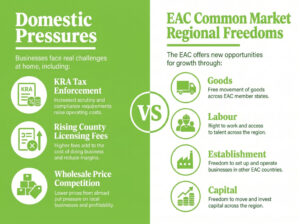
For domestic traders, the pressure comes from three fronts:
- High operating costs: Licensing fees, rents, utilities and other expenses raise the cost of doing business.
- Stricter tax compliance: The Kenya Revenue Authority (KRA) has intensified enforcement, particularly among registered MSMEs.
- Direct wholesale competition: Foreign micro-entrepreneurs with direct links to suppliers in East Asia and neighbouring countries can access goods at prices that local traders struggle to match.
Proposed measures such as the Local Content Bill, 2025, have gained political traction, reflecting efforts to protect domestic retail and distribution channels. Yet addressing legitimate competition concerns through broad restrictions on foreign participation could have wider consequences for Kenya’s competitiveness and its commitments to the EAC.
That is where the domestic debate becomes regional. What Nairobi may view as a necessary intervention to protect local traders, EAC partners may interpret as a restriction on rights guaranteed under the Common Market Protocol.
The EAC Dilemma: Free Movement vs. National Reservation

Kenya’s regulatory response therefore sits within a broader regional integration framework. The EAC Common Market Protocol guarantees four core freedoms:
- Free Movement of Goods: Elimination of internal tariffs and non-tariff barriers (NTBs).
- Free Movement of Labour and Persons: Nondiscriminatory treatment of EAC citizens and provisions governing movement for work.
- Right of Establishment: The ability of EAC nationals to establish businesses across partner states without discriminatory barriers.
- Free Movement of Capital: The ability to move capital across borders for investment.
When municipal authorities or national ministries issue broad directives targeting non-national traders, regional partners, particularly Uganda, Tanzania and Burundi, may view such measures as non-tariff barriers that undermine Treaty obligations. Historical tensions within the EAC show how unilateral market restrictions can trigger retaliatory measures, from administrative delays at border posts to targeted restrictions on goods.
The policy challenge, therefore, is not simply whether Kenya should protect its small traders. It is how to do so without creating new barriers within a market designed to remove them.
Strategic Policy Imperatives
Navigating this trade-off requires a balanced, legally sound approach that protects domestic micro-enterprises without jeopardising regional integration:
- Precision Regulation Over Blanket Bans: The Ministry of Trade should clearly distinguish between EAC nationals, who are protected under regional treaty commitments, and third-country nationals, who fall under a different regulatory framework.
- Transparent Threshold Alignment: Establish clear and predictable capital-investment thresholds distinguishing wholesale foreign direct investment (FDI) from micro-retail trading. This would close regulatory loopholes while maintaining treaty commitments.
- Harmonised Regional Frameworks: Use EAC sectoral committees to harmonise definitions of retail trading and work-permit protocols across partner states, reducing regulatory uncertainty and non-tariff friction.