

Kenya Weathers External Shocks as Domestic Challenges Test Economic Resilience
Kenya’s private-sector activity slipped into contraction in August, as higher input costs, material shortages, and weaker purchasing weighed on output.
However, economists noted that new orders rose for a third consecutive month, employment increased, and business expectations improved to their strongest level since February 2023. Input cost inflation also eased, while firms raised output prices at the slowest pace in four months.
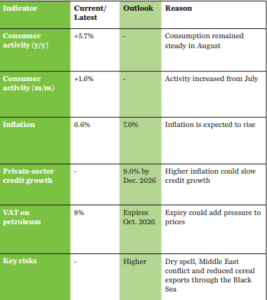
In August, the headline Purchasing Managers’ Index (PMI) fell to 49.7, down from 51.3 in July. The decline was partly due to supply-side logistical challenges at the port after the Kenya Revenue Authority (KRA) introduced a digital pre-arrival system. The system requires shippers to obtain a reference cost before loading cargo, causing bottlenecks and delays. Some of these disruptions may be temporary and could ease in September.
In addition, the government declared a severe national drought emergency across 20 counties, with a projected 30 to 40 per cent decline in the 2026 cereal harvest due to prolonged dry spells and climate change.
The dry spell has caused near-total crop failure in maize and wheat, disrupted the rice crop cycle, and choked dairy production.
In the year to July 2026, milk consumption in the formal sector fell by 2.3 per cent compared with the same period in 2025. Meanwhile, the Foreign Agricultural Service (FAS) estimates that corn and wheat production could be halved in the financial year 2026/27.
This local production gap means that Kenya needs to import roughly two million metric tonnes of wheat and maize, and 1.1 million metric tonnes of rice. This comes amid disruptions along the Black Sea channel and local delays in issuing import permits, which could put further upward pressure on costs. Additionally, this shock is expected to be immediately followed by El Niño, which has historically damaged acres of land, risking further disruption to the food supply.
Positively, additional rainfall is expected to improve the country’s maize, coffee, sugar, and fruit yields. Taken together, economists expect the agricultural sector to grow by just 2.0 per cent this year, down from 3.1 per cent in 2025. This is likely to have adverse spillover effects across the agricultural value chain, including agro-processing, transport, and trade. Hence, they envisage that economic growth could underperform the 2025 growth of 4.6 per cent more materially.
Consumer Activity
According to the NCBA-Consumer Activity Index, consumption activity was steady. In August, the index rose 5.7 per cent year-on-year (y/y) and 1.6 per cent month-on-month (m/m), supported by school-holiday-related spending, back-to-school purchases in late August, and recreational activities.
However, general prices in the economy remain elevated, and the outlook is increasingly uncertain owing to the ongoing domestic dry spell, the Middle East conflict, and reduced cereal exports through the Black Sea. Further, a lower VAT rate of 8 per cent on petroleum fuel expires in October 2026.
Therefore, economists project inflation to move towards 7.0 per cent in the near term, from the current level of 6.6 per cent. This puts consumption growth at risk and could consequently slow private-sector credit growth slightly, with growth averaging 9.0 per cent through December.
Fiscal Front
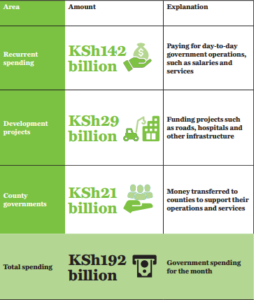
The July Exchequer report indicates a solid start to the current financial year, with 14 per cent growth in tax revenues compared with the previous year and robust domestic borrowing. Consequently, government expenditure for the month included KSh142 billion allocated to recurrent expenses, KSh29 billion directed towards development initiatives, and KSh21 billion disbursed to county governments. For the rest of Q3, proceeds from Treasury Bills and government bonds should sustain regular government spending.
Q4 Predictions
Economists note that Q4 is a noteworthy period, particularly as government spending ramps up while external financing conditions tighten. The government is expected to approach the Eurobond market to raise US$815 million (KSh105.47 billion) and to secure commercial loans from alternative sources.
Positively, for now, market liquidity and interest rates appear stable, indicating a likely success in raising funds from the domestic market.
Externally, higher imported commodity prices are expected to put pressure on the import bill, although economists posit that export seasonality in tourism, coffee, and tea will offset some of this impact.
Moreover, the foreign exchange reserve buffer is ample, providing a strong cushion against exchange-rate volatility. However, an escalation in the Middle East that pushes Brent materially above US$100 (KSh12,939) would create an adverse scenario for inflation, interest rates, and external financing costs.