
Funding Gaps Threaten to Slow IEBC Preparations for 2027 Polls
The Independent Electoral and Boundaries Commission (IEBC) budget shortfall risks undermining the delivery of a credible, transparent, peaceful and inclusive general election next year.
The commission has received only about half of the KSh48.7 billion, with shortfalls affecting general administration, voter education, and ICT, making timely financing, schedule adherence, and early legal or regulatory reforms essential.
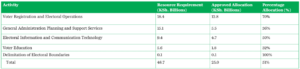
The approved budget allocated KSh25 billion to the electoral body, leaving an overall financing gap of KSh23.7 billion. The Parliamentary Budget Office (PBO) says this substantial resource deficit underscores the need for sustained resource mobilisation, expenditure rationalisation, and prioritisation of critical electoral activities to ensure timely preparedness and safeguard the integrity and credibility of the electoral process.
According to the PBO’s latest report, “2026 Budget Watch”, voter registration and electoral operations have been allocated KSh12.8 billion, comprising KSh3.2 billion for voter registration and KSh9.6 billion for electoral operations.
IEBC projects that the register of voters will increase from the current 22.1 million to approximately 28.5 million by 2027, through the registration of an additional 6.4 million eligible voters.
The electoral body is also expanding voter registration for citizens residing outside Kenya to 26 countries, up from 12. As of August 2026, the IEBC has registered 2.9 million eligible voters, indicating an achievement of 45 per cent.
The voter verification and audit of the register are expected to continue and be completed 60 days before the general election, which will be held on August 10, 2027. The allocations for electoral operations are to be utilised for the procurement of strategic and non-strategic materials. This is expected to be completed within the 2026/27 financial year, in good time for the general election.
In addition, general administration planning and support services constitute a significant component of election preparedness despite the minimal allocation provided.
The funds are mainly used for training and remuneration of electoral poll officials, transport and logistics equipment, election planning and operations, and legal fees. Adequate financing of these activities is essential to ensure the efficient administration and credibility of the poll process.
Despite a requirement of KSh15.1 billion, IEBC was allocated KSh5.5 billion, which may be inadequate, and budgetary shortfalls are already evident across all these critical areas. In addition, IEBC has accumulated pending bills amounting to KSh5.6 billion as at June 30, 2025, largely attributable to legal fees and election logistics.
These outstanding obligations may constrain the electoral body’s fiscal space and adversely affect the timely implementation of election preparedness activities if left unaddressed.
Additionally, electoral technology remains a cornerstone of modern election management and is critical to the integrity of the electoral process. The IEBC has been allocated KSh4.7 billion.
The funding will be used for ICT-related interventions, including the replacement of the Kenya Integrated Management System (KIEMS) kits, the upgrading of electoral systems, simulation exercises, and the implementation of the Candidate Registration Management System.
Source: IEBC
Nevertheless, the allocated amount is insufficient, as the requirement was KSh9.4 billion. The shortfall will adversely affect the ICT interventions, with the most significant impact on the acquisition and replacement of KIEMS kits, which are integral to voter identification, voter verification, and results transmission.
Moreover, legal and institutional reforms are integral to preparedness. The successful conduct of elections depends not only on adequate financing and operational readiness but also on a stable, coherent, and predictable framework.
The electoral body indicated that it intends to present proposed amendments to electoral laws and regulations to Parliament, aimed at addressing emerging challenges and strengthening electoral dispute resolution mechanisms. This is intended to enhance the integrity of electoral processes and align the legal framework with evolving technological developments in election management.
Timely enactment of electoral reforms is critical to providing certainty to stakeholders, facilitating effective planning and implementation, and minimising the risk of litigation and operational disruptions during the electoral cycle.
Therefore, the report states that any outstanding legislative and regulatory amendments should be finalised sufficiently before the end of the 2026/27 financial year to allow adequate time for implementation, stakeholder sensitisation, institutional adaptation, and capacity building before the August polls.
What’s Required
To ensure adequate preparation, the Parliamentary Budget Office recommends that Parliament should, first, address the bottlenecks to election preparedness and, second, adhere to the implementation schedule.
Although significant progress has been made in preparations through enhanced allocations, strategic planning, and institutional interventions, considerable financing gaps remain in voter registration, election operations, and electoral technology.
Parliament should ensure that these are adequately addressed alongside the timely implementation of electoral reforms; it will be imperative to ensure that the country is adequately prepared to deliver a credible, peaceful, and well-administered electoral process next year.
Finally, Parliament should also monitor and ensure that the IEBC indicative implementation schedule for the 2027 polls is followed to guarantee the independence, accountability, transparency, and professionalism of the process.