

Beyond Registration: How Far Does SHA Cover Kenyan Families?

When Kenya enacted the Social Health Insurance Act, it marked a fundamental pivot away from the legacy National Hospital Insurance Fund (NHIF) model. Rather than relying on a voluntary, employment-linked safety net, the country adopted a statutory framework comprising three dedicated, risk-pooled funds: the Primary Healthcare Fund, the Social Health Insurance Fund (SHIF), and the Emergency, Chronic, and Critical Illness Fund (ECCIF).
At the Kenya Health Summit at KICC, held on 18 and 19 August under the theme “Reforms Delivered, Health as a Right”, President William Ruto, Health Cabinet Secretary Aden Duale, and Ministry officials reviewed progress on structural reforms. More than 32.3 million citizens have been onboarded across 10,000+ accredited facilities, and more than 7.9 million claims totalling KSh178 billion have been disbursed to healthcare providers. Yet transitioning a nation of over 50 million to a unified health finance model creates operational friction points and raises a critical question for patients and healthcare providers: to what extent does the SHA actually pay?
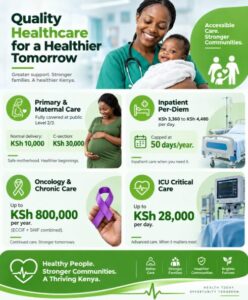
Quick Tariff Snapshot (Legal Notice No. 78 of 2026)
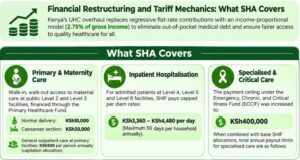
Financial Restructuring and Tariff Mechanics: What SHA Covers
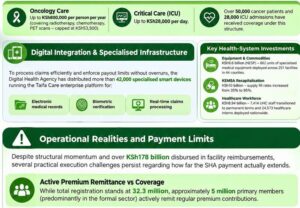
Co-Payments and Balance Billing: Because SHA operates under fixed per-diem and procedure-based tariff caps, patients must still pay out-of-pocket for costs exceeding these fixed amounts (e.g., specialised private hospital stays beyond the daily inpatient limit or extended ICU stays beyond the ECCIF threshold).
Private Provider Claims Liquidity: Maintaining predictable reimbursement cycles for faith-based and private hospitals (which constitute nearly half of all accredited SHA facilities) is critical to preventing facilities from rejecting SHA cards or demanding cash co-payments from patients when payment caps are reached.
Kenya’s transition to the Social Health Authority represents one of the most ambitious structural overhauls of health finance in Sub-Saharan Africa. While tariff ceilings provide substantial protection against major medical bills, retaining active contributions and balancing fixed payout limits against actual care costs will determine whether the statutory blueprint fully translates into equitable bedside care.