

From Inventory to Identity: The Legal and Operational Shift in Kenya’s 6-Month SIM Recycling Mandate
For over two decades, Kenya’s telecommunications sector operated under a straightforward commercial logic: SIM cards were operational assets leased to consumers. If a subscriber failed to generate revenue on a line for 90 days, mobile network operators (MNOs) routinely deactivated the SIM, purged its registration logs, and recycled the number back into the public inventory.
That era of swift “use-it-or-lose-it” number recycling is ending. Following landmark draft guidelines published by the Communications Authority of Kenya (CA), telcos including Safaricom, Airtel, and Telkom Kenya will soon be legally required to wait at least six months before fully deactivating and reassigning inactive lines.
This is not merely an operational extension of a grace period; it represents a fundamental reclassification of mobile phone numbers in Kenya, moving them from temporary commercial inventory to constitutionally protected elements of digital identity.
The Judicial Catalyst: Numbers as Digital Assets
The momentum behind the CA’s new framework stems directly from a March 19, 2026, High Court ruling delivered by Justice Lawrence N. Mugambi. The court evaluated a petition brought on behalf of incarcerated citizens whose mobile lines were deactivated and recycled while serving prison terms, allowing new line holders to inherit access to their private communications, mobile money accounts, and personal data.
Justice Mugambi ruled that arbitrarily recycling phone numbers creates severe security risks and violates a citizen’s constitutional right to privacy under Article 31. Because a mobile number in Kenya serves as the single primary anchor for identity verification linked directly to KRA PINs, National IDs, M-Pesa wallets, banking alerts, two-factor authentication (2FA) codes, and eCitizen portals, reassigning a line without rigorous safeguards compromises digital identity.
The High Court gave the State a strict six-month window, lapsing at midnight on September 19, 2026, to establish robust statutory and technical safeguards. The CA’s draft guidelines, published on September 1, 2026, directly fulfil that judicial directive.
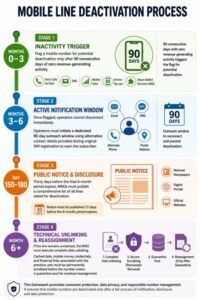
How the Proposed 6-Month Deactivation Process Works
The proposed framework replaces single-stage deactivation with a structured, multi-tier compliance pipeline designed to maximise subscriber notification:
Special Circumstances & Safelisting Frameworks
To address real-world disruptions where subscribers cannot use their phones for extended periods, the CA has introduced formal “whitelisting” mechanisms:
- Inmate Protection: Within three months of a court conviction carrying a sentence longer than six months, the Commissioner-General of Prisons can submit prisoner registries to MNOs. These numbers will be safelisted and protected from auto-deactivation for the duration of incarceration.
- Indisposed Subscribers: Caregivers or family members can submit in-person requests supported by original identification documents to safelist lines belonging to individuals who are hospitalised, studying abroad, or incapacitated. Safelisting grants a 12-month renewable protection status.
- Subscriber Self-Audit via *106#: All public notices issued by MNOs must feature the unified *106# USSD shortcode, allowing citizens to quickly verify which SIM cards are registered under their National ID and check their active operational status.
Strategic Impact on Telecoms and Consumers
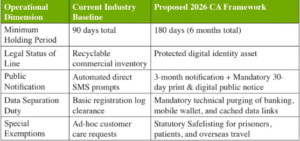 For telecommunications operators, the rule shifts inventory economics. Holding dormant MSISDN batches for six months increases inventory carrying costs and restricts available numbering blocks. However, for consumers, financial institutions, and data privacy regulators, the framework closes a massive loophole that previously enabled identity theft, unauthorised M-Pesa takeovers, and data privacy breaches via recycled phone lines.
The Communications Authority’s public consultation period remains open until September 11, 2026. Stakeholders across legal, tech, and financial sectors are submitting feedback to numbering@ca.go.ke before these procedures become binding law ahead of the court’s September 19 deadline.