
Beyond Registration: How Far Does SHA Cover Kenyan Families?
When Kenya enacted the Social Health Insurance Act, it marked a fundamental pivot away from the legacy National Hospital Insurance Fund (NHIF) model. Rather than relying on a voluntary, employment-linked safety net, the country adopted a statutory framework comprising three dedicated, risk-pooled funds: the Primary Healthcare Fund, the Social Health Insurance Fund (SHIF), and the Emergency, Chronic, and Critical Illness Fund (ECCIF).
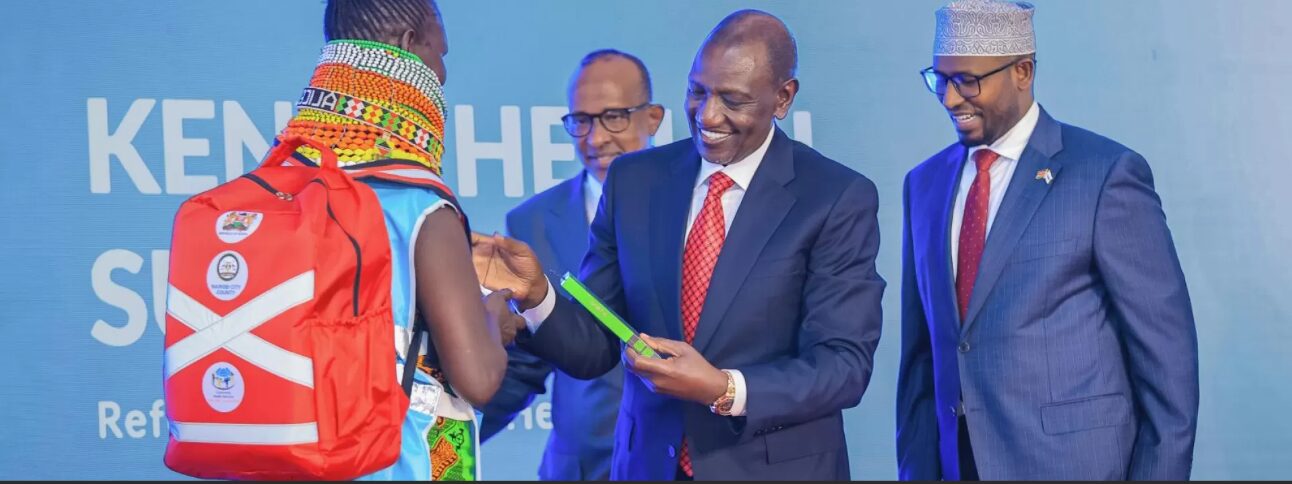
At the Kenya Health Summit at KICC, held on 18 and 19 August under the theme “Reforms Delivered, Health as a Right”, President William Ruto, Health Cabinet Secretary Aden Duale, and Ministry officials reviewed progress on structural reforms. More than 32.3 million citizens have been onboarded across 10,000+ accredited facilities, and more than 7.9 million claims totalling KSh178 billion have been disbursed to healthcare providers. Yet transitioning a nation of over 50 million to a unified health finance model creates operational friction points and raises a critical question for patients and healthcare providers: to what extent does the SHA actually pay?
Quick Tariff Snapshot (Legal Notice No. 78 of 2026)
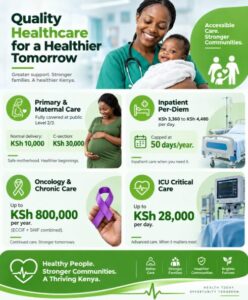
Primary & Maternal Care: Fully covered at public Level 2/3 (Normal delivery: KSh10,000 | C-section: KSh30,000).
Inpatient Per-Diem: KSh3,360 to KSh4,480 per day (Capped at 50 days/year).
Oncology & Chronic Care: Up to KSh800,000 per year (ECCIF + SHIF combined).
ICU Critical Care: Up to KSh28,000 per day.
Financial Restructuring and Tariff Mechanics: What SHA Covers
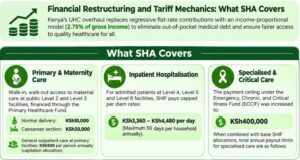
The primary objective of Kenya’s UHC overhaul is to replace regressive flat-rate contributions with an income-proportional model (2.75% of gross income) to eliminate out-of-pocket medical debt.
To expand access at lower-level facilities while maintaining fiscal sustainability, the Ministry of Health established updated reimbursement limits and standardised tariffs under Legal Notice No. 78 (Tariffs for Healthcare Services Amendment):
Primary & Maternity Care: Walk-in, walk-out access to maternal care at public Level 2 and Level 3 facilities is financed directly through the Primary Healthcare Fund, with standard limits of KSh10,000 for normal deliveries and KSh30,000 for Caesarean sections. The Summit highlighted increased maternity investments, including the ‘Every Woman Every Newborn Everywhere’ initiative and the recruitment of 5,000 additional nurses and midwives to support frontline care. General outpatient care at primary facilities is covered by a fixed capitation allocation of KSh900 per person annually.
Inpatient Hospitalisation: For admitted patients at Level 4, Level 5, and Level 6 facilities, SHIF pays capped per diem rates ranging from KSh3,360 to KSh4,480 per day, with a maximum of 50 days per household annually.
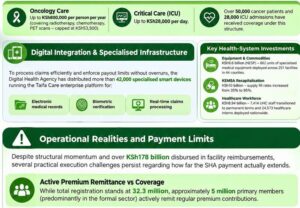
Specialised & Critical Care: The payment ceiling under the Emergency, Chronic, and Critical Illness Fund (ECCIF) was increased to KSh400,000. When combined with base SHIF allocations, total annual payout limits for oncology care (covering radiotherapy, chemotherapy, and advanced diagnostics such as PET scans, capped at KSh53,500) reach up to KSh800,000 per person per year. Critical care in ICU units is paid at tariffs of up to KSh28,000 per day. Under this structure, over 50,000 cancer patients and 28,000 ICU admissions have received coverage.
Digital Integration & Specialised Infrastructure
To process claims efficiently and enforce payout limits without overruns, the Digital Health Agency has distributed more than 42,000 specialised smart devices running the Taifa Care enterprise platform for electronic medical records, biometric verification, and real-time claims processing.
To support these payment mechanisms at the facility level, the Summit highlighted key health-system investments:
Equipment & Commodities: Through the KSh9.6 billion National Equipment Service Programme (NESP), 862 units of specialised medical equipment have been deployed across 251 health facilities in 44 counties to reduce unnecessary referral travel. In parallel, a KSh10 billion recapitalisation of KEMSA increased supply fill rates from 35% to 95%.
Healthcare Workforce: An allocation of KSh8.94 billion transitioned 7,414 UHC staff to permanent terms and supported the deployment of 24,573 healthcare interns nationwide.
Operational Realities and Payment Limits
Despite structural momentum, with over KSh178 billion disbursed in facility reimbursements, several practical execution challenges persist regarding how far the SHA payment actually extends:
Active Premium Remittance vs Coverage: While total registration stands at 32.3 million, approximately 5 million primary members (predominantly in the formal sector) actively remit regular premium contributions. Expanding active, recurring collections across the informal economy remains essential to sustain the fund.
Co-Payments and Balance Billing: Because SHA operates under fixed per-diem and procedure-based tariff caps, patients must still pay out-of-pocket for costs exceeding these fixed amounts (e.g., specialised private hospital stays beyond the daily inpatient limit or extended ICU stays beyond the ECCIF threshold).
Private Provider Claims Liquidity: Maintaining predictable reimbursement cycles for faith-based and private hospitals (which constitute nearly half of all accredited SHA facilities) is critical to preventing facilities from rejecting SHA cards or demanding cash co-payments from patients when payment caps are reached.
Kenya’s transition to the Social Health Authority represents one of the most ambitious structural overhauls of health finance in Sub-Saharan Africa. While tariff ceilings provide substantial protection against major medical bills, retaining active contributions and balancing fixed payout limits against actual care costs will determine whether the statutory blueprint fully translates into equitable bedside care.