

More Revenue, Lower Costs: Kenya’s Fiscal Challenge Ahead of 2027

Kenya’s FY2027/28 budget cycle begins against a difficult fiscal backdrop. The economy remains relatively resilient, with GDP growth projected at 5.0 per cent in 2026 and 5.1 per cent in 2027. That resilience, however, has not eased the pressure on public finances. The government continues to face revenue shortfalls, a sizeable fiscal deficit and limited room to borrow. The central challenge for the 2027 Budget will be to raise more revenue without making it harder for businesses to invest, employ and grow.
The 2026 Budget Review and Outlook Paper (BROP) offers an early indication of how the Government plans to strike that balance. Its approach centres on improving tax collection, controlling spending and creating a more predictable environment for businesses and investors.
Raising Revenue Without Stifling Growth
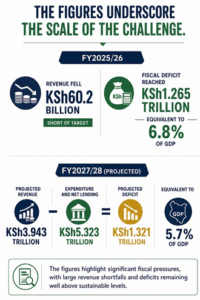
Public debt adds to the pressure, with Kenya assessed as being at high risk of debt distress. The government is therefore targeting domestic revenue of 17.5 per cent of GDP by FY2029/30, while keeping total expenditure below 21.4 per cent of GDP.
The issue, however, is not simply how to collect more. It is how to do so without raising the cost of doing business or weakening economic activity.
The BROP points towards greater emphasis on tax compliance, improved administration and a broader tax base, rather than relying entirely on higher tax rates. The implementation of the National Tax Policy and the Medium-Term Revenue Strategy is intended to provide greater clarity on tax rates and the tax base, giving businesses more certainty when making investment decisions.
That predictability matters. Improving compliance and bringing more economic activity into the tax net could strengthen government revenues without imposing a disproportionate burden on businesses already paying taxes. Continued digitisation of tax administration could also make tax collection more efficient while reducing some compliance costs.
Cutting Costs for Businesses
Revenue measures, however, cannot be considered in isolation from the wider cost of operating in Kenya. New taxes, regulatory delays, late government payments and other business costs could discourage investment and expansion.
This makes efforts to improve the business environment equally important. Clearing verified outstanding bills would inject liquidity into businesses, particularly in sectors such as construction and road infrastructure. Regulatory reforms could reduce bottlenecks, while Public-Private Partnerships could attract private capital to infrastructure projects and ease pressure on government finances.
Spending will also face greater scrutiny. The shift towards Zero-Based Budgeting means Ministries, Departments and Agencies will increasingly have to justify existing and proposed programmes. In principle, this should direct scarce resources towards areas with a clearer economic return, including infrastructure, productivity, job creation, and value chain development.
Engaging Early
For the private sector, timing will be important. Public hearings scheduled for 12th to 14th October 2026, followed by Sector Working Group consultations later in the month, offer businesses an opportunity to shape proposals before they inform the 2027 Budget Policy Statement.
Waiting until the Finance Bill in January 2027 could mean engaging after many key decisions have already been made.
Ultimately, the 2027 Budget will test whether Kenya can raise sufficient revenue to put its finances on a more sustainable footing without weakening the businesses and households that generate it.
Fiscal consolidation is therefore not simply about collecting more and spending less. It is about creating an environment in which businesses can invest, expand and create jobs. At the same time, the government improves the efficiency and value for money of every shilling it collects and spends.