

Holding the Line: Why Kenya Is Doubling Down on Sugar Self-Sufficiency
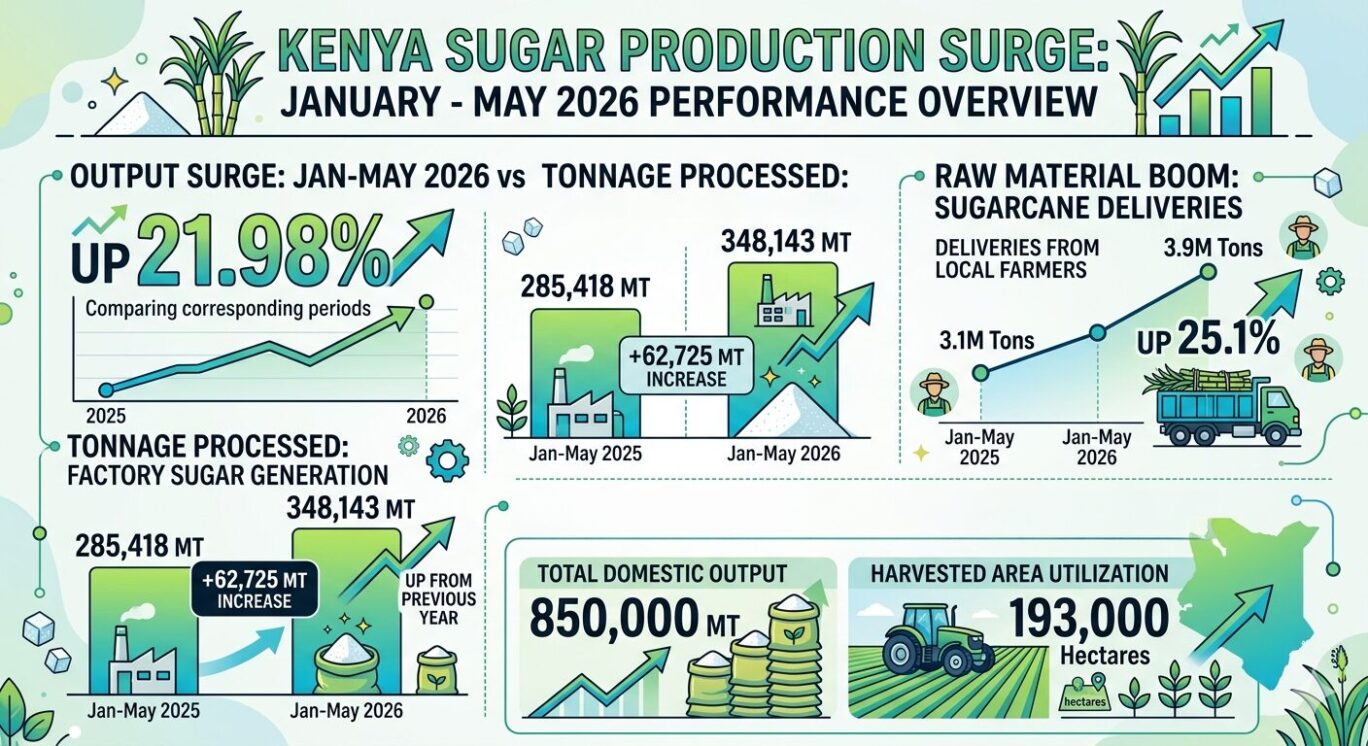
The government has reaffirmed its ban on sugar imports and frozen the issuance of new import licences, arguing that domestic production is now sufficient to meet local demand without relying on foreign sugar. The decision marks one of the strongest policy signals yet that the government intends to shield local producers from import competition as it pushes for long-term self-sufficiency in the sector.
Speaking at a consultative meeting with farmers and industry stakeholders, Agriculture and Livestock Development Cabinet Secretary Mutahi Kagwe said Kenya had produced enough sugar to meet domestic demand and warned that imports risked destabilising local prices and undermining farmers’ incomes.
“I have asked the Kenya Sugar Board to stop sugar imports. Henceforth, I do not want any licence issued for sugar imports,” the Cabinet Secretary said, adding that the government would not allow imports to undermine the local industry as Kenya works towards becoming a sugar-exporting country.
The announcement is more than a temporary trade restriction. It signals a broader shift in agricultural policy, from managing sugar shortages to protecting domestic production.
A Turning Point for the Sugar Industry
For decades, Kenya’s sugar sector has struggled to meet domestic demand. Low productivity, ageing factories, delayed payments to farmers, and competition from cheaper imported sugar have left the country reliant on imports to bridge supply gaps. Successive governments relied on import permits to stabilise the market, particularly during periods of low production.
That picture appears to be changing. According to the Ministry of Agriculture, sugar imports have fallen sharply from about 210,000 metric tonnes last year to approximately 60,000 metric tonnes this year, suggesting that domestic production has improved significantly. The government now argues that the market no longer requires imported sugar on the scale seen in previous years.
Protection Through Policy
Import restrictions are not the only changes affecting the industry. The Finance Act, 2026, added a tax of KSh40 per kilogramme on imported sugar, which has already led millers to import less and reduced import volumes. Keeping the import ban adds to this, supporting the government’s plan to boost local production and make imported sugar less attractive.
These steps form a clear policy plan: use taxes to cut down on imports and control licences to protect local producers. Supporters say that without these actions, local millers and sugarcane farmers would have a hard time competing with cheaper imports, especially from bigger and more efficient sugar-producing countries.
However, critics warn that if protection lasts too long without wider reforms, it can lower competition and make people less likely to invest in better productivity.
Raising the Bar for New Millers
Alongside the import ban, the government has announced stricter licensing conditions for new sugar factories.
Under the proposed framework, investors seeking milling licences will be required to demonstrate that they have adequate nucleus estates and contracted outgrowers before approval is granted. The move is intended to address one of the industry’s longstanding challenges cane poaching, where multiple mills compete for the same farmers instead of investing in sustainable cane development.
The government argues that requiring investors to secure their own cane supply before establishing factories will create a more stable production environment and reduce disputes between millers. It also shifts the focus from simply increasing the number of factories to strengthening the sustainability of the supply chain that supports them.
Reform Beyond Imports
The government’s new announcements come as the sugar sector is going through bigger changes. The Kenya Sugar Board is getting ready for elections on 5 September 2026, which is an important step in putting the Board in place under the Sugar Act, 2024. Once set up, the Board will handle key decisions for the industry, like managing the Sugar Development Levy.
Farmer representatives have welcomed the elections. They believe that having an elected board will speed up the new legal changes and give farmers a stronger voice in how the sector is run.
The meeting also showed that some problems are still not solved. Farmers from Busia and Nzoia said they are worried about late payments, and the government confirmed that KSh265 million in old debts is still unpaid. Cabinet Secretary Kagwe said talks with the National Treasury are ongoing to help pay off the rest.
Infrastructure also featured prominently in the discussions, with farmers calling for the release of funds earmarked under the Sugar Development Levy to improve sugar roads, expand cane development programmes and strengthen farmer advocacy organisations.
The Bigger Picture
The government’s decision reflects a broader shift in agricultural policy. Across several sectors, policymakers are placing greater emphasis on domestic production, value addition and reducing reliance on imports. The sugar industry has become one of the clearest examples of that strategy in practice.
Long-term success will depend on whether local production continues to grow, factories become more efficient, farmers receive timely payments and governance reforms under the Sugar Act deliver the structural changes the industry has long demanded.
For the first time in many years, the conversation is no longer centred on how much sugar Kenya needs to import. It is about whether the country can produce enough to stand on its own.