

Speed, Secrecy and Division: Kenya’s Week from Oyo to Milimani
This week, Kenya’s politics unfolded across three very different settings: Oyo in the Democratic Republic of the Congo, the courtrooms of Milimani, and opposition rallies stretching from Eastleigh to Maryland in the United States. At first glance, these seem like separate developments. But together, they reveal the competing pressures shaping the country’s political landscape ahead of the August 2027 General Election.
While President William Ruto’s administration is moving to secure diplomatic and economic gains, the courts are testing the limits of executive authority, and an increasingly fragmented opposition is positioning itself for the electoral contest.
Why Ruto Made a Detour to Oyo
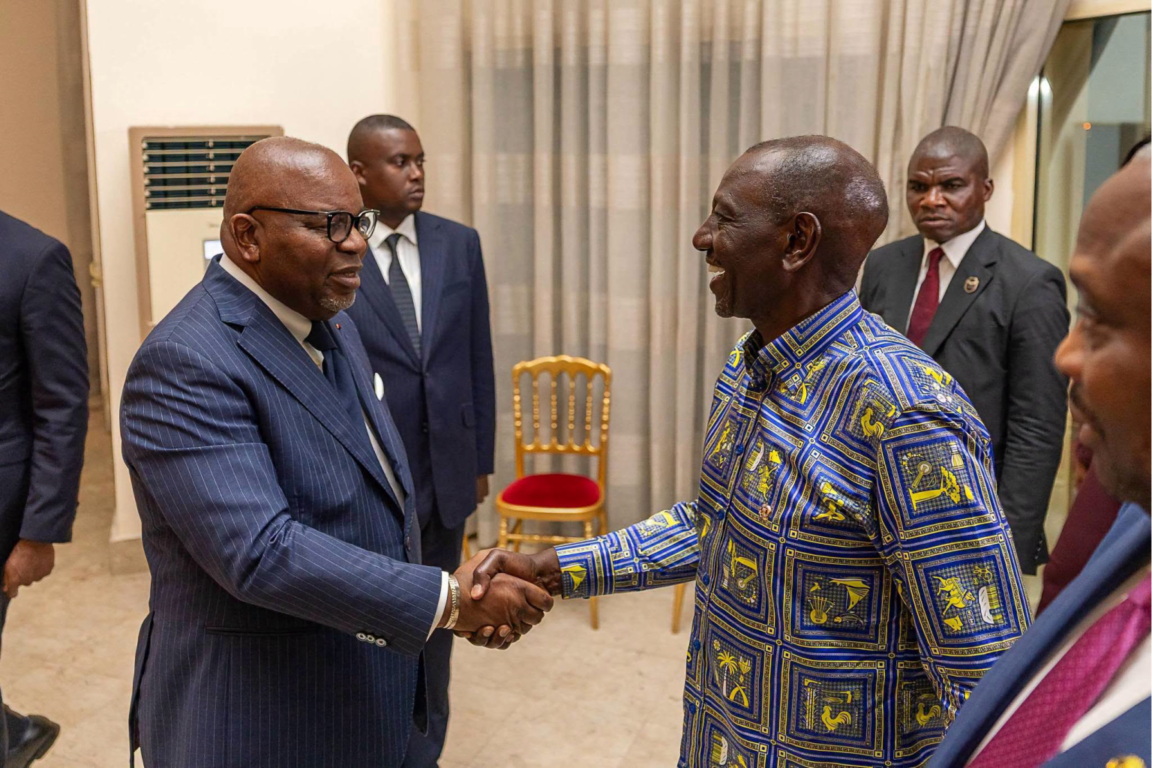
The week began with an unexpected change to President Ruto’s schedule. Midway through a development tour of Western Kenya, he cut short his engagements and travelled overnight to Oyo to meet DRC’s president, Félix Tshisekedi.
The meeting, facilitated by Congolese President Denis Sassou N’Guesso and Togolese mediator Faure Gnassingbé, offered an opportunity to repair diplomatic relations between Nairobi and Kinshasa, which had been strained since December 2023. Tensions arose after Congolese opposition leaders and figures associated with the M23 rebel movement convened in Nairobi to launch the Congo River Alliance, an initiative Kinshasa viewed as hostile.
The fallout included the recall of the DRC’s ambassador to Kenya, the rejection of two Kenyan ambassadorial nominees and a breakdown in normal diplomatic engagement.
For Nairobi, restoring relations has significant economic implications. Kenyan banks, led by Equity and KCB, have substantial exposure to the DRC, with estimated assets of KSh933.4 billion. The DRC is also an increasingly important export market for Kenyan businesses, making stable diplomatic relations essential to protecting commercial interests.
The Oyo meeting resulted in an agreement to restore ambassadorial exchanges, revive the Joint Permanent Commission and continue regional security discussions through the East African Community and the Great Lakes regional framework.
Ruto later returned to Western Kenya, where he announced a KSh1.2 billion bonus for Nzoia Sugar farmers. The sequence of events illustrated the administration’s efforts to pursue diplomatic engagement abroad while maintaining its domestic development agenda.
When Executive Speed Meets Judicial Scrutiny
The administration’s pace of decision-making, however, faced a different test at Milimani, where two High Court rulings raised questions about executive authority, constitutional compliance and transparency.
In a public-interest petition filed by Francis Njoroge Wanjiku, High Court Judge Roselyne Aburili declared the creation of seven State Departments under Executive Order No. 1 of 2025 unconstitutional. The court found that the restructuring had bypassed mandatory oversight by the Public Service Commission and public participation.
To avoid disrupting government operations, the judge suspended the ruling’s effect for six months, giving the administration time to address the constitutional shortcomings. The affected departments include Public Investments and Assets Management; National Government Coordination; Justice and Constitutional Affairs; Aviation and Aerospace Development; Science and Research; and Special Programmes and Children’s Welfare Services.
In a separate ruling, the High Court also quashed a government agreement with the United States to establish an Ebola isolation and treatment facility at Laikipia Air Base for US personnel. The court declared the agreement unconstitutional and ordered the Government to make the relevant documentation public.
The two decisions came just over a week after Ruto’s November 18 State of the Nation Address, in which his administration outlined its development and governance agenda. Together, the rulings underscored an important constitutional principle: executive decisions, regardless of their policy objectives or urgency, must comply with the law and established procedures.
An Opposition Still Struggling for Unity
The court rulings allowed the opposition to challenge the administration’s record on governance and constitutional accountability. Yet, instead of presenting a united political front, opposition figures spent much of the week pursuing separate political agendas.
On Wednesday 25, veteran Jubilee Party official Jeremiah Kioni resigned as Deputy Party Leader, ending an 11-year association with the party. In his letter to Acting Party Leader Fred Matiang’i, Kioni said he intended to form a new political outfit. His departure adds another layer of uncertainty to an opposition landscape already characterised by competing interests and leadership ambitions.
Meanwhile, Democracy for the Citizens Party leader Rigathi Gachagua took his political campaign to Eastleigh, Nairobi, where he criticised leaders from the North Eastern region over their management of devolved resources. He also gave the Independent Electoral and Boundaries Commission (IEBC) a January deadline to audit the voter register.
In the United States, Nairobi Senator Edwin Sifuna used a diaspora town hall in Maryland to formally declare his intention to contest the presidency in 2027.
These developments illustrate the opposition’s growing political activity but also the challenge of building a common platform. With several figures seeking to shape the next electoral contest, questions remain about potential alliances, leadership arrangements and the possibility of a unified opposition strategy.
The Road to 2027
With 256 days remaining before the August 2027 General Election, the week’s events offered a snapshot of the political forces shaping Kenya’s next electoral cycle.
The Ruto administration is seeking to build momentum through diplomatic engagement, economic initiatives and visible development commitments. However, High Court rulings show that the pace of executive action remains subject to constitutional oversight, particularly regarding public participation, institutional mandates and transparency.
For the opposition, the challenge is different. It has opportunities to scrutinise the Government’s record, particularly on governance and accountability, but must contend with competing ambitions and the absence of a clearly consolidated political strategy.
Ultimately, the contest ahead will be shaped not only by what the Government delivers or what the opposition promises, but also by how effectively both sides respond to public expectations, constitutional obligations and the country’s economic realities.
For now, State House is moving quickly, the courts are demanding accountability, and the opposition is still working out how to turn its individual political ambitions into a collective electoral proposition.