

Following the Money: Kenya’s New Push for Financial and Crypto Transparency

Kenya is moving to strengthen tax transparency across both traditional banking and the growing digital asset market, with new draft regulations that could significantly expand reporting and compliance obligations for financial institutions and crypto-asset service providers.
The Kenya Revenue Authority (KRA), on behalf of the National Treasury, has published the Draft Tax Procedures (Common Reporting Standards) Regulations, 2026, and the Draft Tax Procedures (Crypto Assets Reporting Framework) Regulations, 2026, for public participation. The proposals are designed to enhance the collection and exchange of financial information to facilitate identifying reportable accounts and crypto asset transactions across jurisdictions.
The various regimes cover different parts of the financial system, but all share the same aim: to improve visibility into financial activity that might otherwise be difficult for tax authorities to track. The proposals are still in draft form, and stakeholder comments are invited by 8th December 2026.
What Is Being Proposed?
The two frameworks address different reporting channels but set similar expectations for customer identification, record-keeping, and tax transparency.
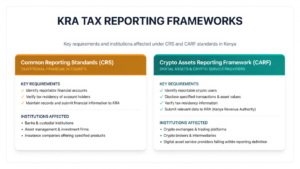 While the CRS framework focuses on reporting financial accounts, CARF broadens tax reporting requirements to cover relevant crypto-asset transactions, including exchanges and transfers conducted outside traditional banking systems.
Strengthening Financial Account Reporting
The proposed CRS Regulations build on Kenya’s existing financial account reporting framework rather than introducing international tax information exchange for the first time.
Under the draft, reporting financial institutions must conduct due diligence to identify accounts held by persons reportable under the framework. This includes verifying tax residency, obtaining relevant self-certifications, and identifying the controlling persons behind certain accounts held by entities.
Institutions would be required to submit their information to KRA electronically by 31st May of the following year (including nil returns where no reportable accounts are identified). Supporting due diligence records would be retained for at least five years after the relevant reporting period.
These requirements place greater emphasis on maintaining accurate customer records, reliable reporting systems, and effective internal controls across the relevant financial institutions. The key operational challenge will be ensuring that tax residency information, customer identification processes, and reporting systems align with the proposed framework.
Bringing Crypto Transactions into View
The second framework examines an increasingly significant area of financial activity: crypto assets.
Under CARF, crypto asset service providers would be required to collect identifying information about reportable users, including relevant tax residency information, and to report relevant transactions to the KRA.
The information would include the aggregate value and volume of certain purchases, disposals, exchanges between crypto assets, and transfers. Transfers to wallet addresses not known to be associated with another service provider or financial institution would also be subject to reporting requirements.
The proposed framework imposes additional compliance obligations on crypto-asset service providers in the areas of customer due diligence, transaction categorisation, valuation, and record-keeping. It’s important to stress that CARF is a tax information reporting framework, not a new tax on every crypto transaction. Its objective is to provide tax authorities with better information rather than to impose a new tax rate.
Operational Implications for Financial Institutions
The proposed regulations are designed to improve tax compliance, but their implementation could impose additional operational pressure on the institutions in question. Banks may need to review their existing customer onboarding processes, update their tax residency documentation, and improve their systems for identifying reportable accounts. Crypto-asset service providers may need to make more significant changes, particularly where their platforms were not built to capture and classify transactions in a way that would satisfy international tax reporting requirements.
These obligations also raise important questions about compliance costs, data protection, system integration, and the ability of smaller institutions to meet reporting requirements.
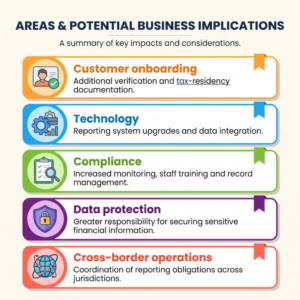 |
The proposed frameworks may well require investment in technology and compliance capacity, even where the institutions in question already have extensive customer information.
Looking Ahead
Kenya’s proposed regulations are part of a broader global trend towards greater transparency in financial transactions, particularly in the context of digital assets, which create new ways of moving and holding value. Their effectiveness will depend on how the reporting obligations are implemented and on the clarity provided to institutions so they can adjust their systems accordingly without causing undue disruption.
As public participation continues, there’s an opportunity for stakeholders to raise practical issues around reporting timelines, implementation costs, data protection, and how different financial products are treated.
The challenge for policymakers will be to enhance tax transparency without creating an unacceptably high compliance burden on the institutions expected to deliver it. The regulations’ success will therefore depend on striking the right balance between improved tax transparency and a reporting regime that is clear, workable, and flexible enough to meet the evolving needs of the financial sector.