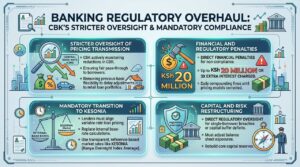

Institutional Integrity vs Yield Pressures: Decoding CBK’s Enforcement Benchmark

The Central Bank of Kenya’s (CBK) 2025 Bank Supervision Annual Report marks a key shift in the supervision of East Africa’s banking sector. The decision to fine 33 commercial banks and subject two others to administrative sanctions, out of 38 audited institutions, is more than regulatory discipline. It highlights clear operational issues linking central bank rate changes, bank balance sheets, and capital requirements.
Only three banks met all credit pricing requirements. For executive leadership, C-suite treasurers, and institutional investors, these findings outline current regulatory standards for bank risk models, interest rate settings, and internal governance.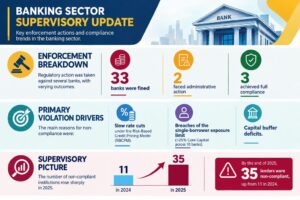
Key Findings: Audit Spectrum (38 Institutions)
- Enforcement Breakdown: 33 banks were fined, two faced administrative action, and only three achieved full compliance.
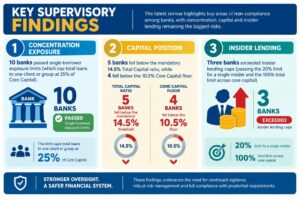
- Primary Violation Drivers: Slow rate cuts under the Risk-Based Credit Pricing Model (RBCPM), breaches of the single-borrower exposure limit (>25% Core Capital across 10 banks), and capital buffer deficits.
- Supervisory Picture: The number of non-compliant institutions rose sharply to 35 lenders by the end of 2025, up from 11 in 2024.
The Rate Transmission Gap
Between August 2024 and August 2025, the Monetary Policy Committee (MPC) cut the Central Bank Rate (CBR) by 350 basis points, lowering the policy rate from 13.0% to 9.5%. The central bank intended to reduce borrowing costs, support business investment, and boost lending to the private sector.
 |
||
Despite these policy cuts, average lending rates remained high across the sector. Commercial banks maintained higher profit margins rather than lowering loan costs for customers, relying on outdated Risk-Based Credit Pricing Models (RBCPM) introduced in 2019.
Risk-Based Credit Pricing: Application and Model Audits
The central focus of the CBK fines concerns the application of the Risk-Based Credit Pricing Model (RBCPM). Approved models calculate loan interest rates using the following standard structure: 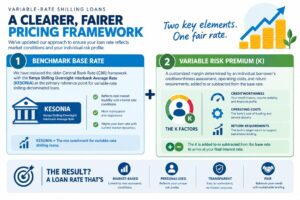
The bank inspection teams reported specific issues in how banks used this formula:
- Asymmetric Risk Charges: Banks raised customer risk charges quickly during economic downturns but rarely lowered them when conditions improved or when borrowers improved their credit scores.
- Internal Base Rates: Banks replaced clear public benchmark rates with internal figures, which hid increased profit margins.
Under the updated RBCPM rules, banks must transition to clear benchmark rates, such as the Kenya Shilling Overnight Interbank Average Rate (KESONIA), to standardise base-rate calculations.

Capital Buffers and Single-Borrower Exposure
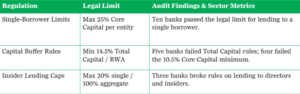
Pricing violations occurred alongside wider compliance issues across bank balance sheets:
What This Means for Commercial Banks
The findings in the 2025 Bank Supervision Annual Report set several clear operational realities for commercial lenders: