

The Return of the Originals: Global Brands Are Betting on Kenya & We Cannot Lose the Wager

The opening of Nike’s first East African flagship store at Sarit Centre was more than a retail launch. Following Adidas Originals’ opening of its first standalone regional store at Westgate Mall, and Hugo Boss’s entry into Kenya’s luxury retail market, this signalled a shift in the country’s commercial landscape. For years, leading global brands reached Kenyan consumers through distributors, franchised retailers and informal supply chains. Today, more are choosing an official presence, bringing authenticated products, controlled customer experiences and direct investment.
To shoppers, this means easier access to genuine products and after-sales support. To investors, policymakers and intellectual property practitioners, it tells a larger story: Kenya is increasingly seen as a market where global brands can protect reputation, cultivate loyalty and safeguard the intellectual property that underpins commercial value.
A Vote of Confidence in Kenya’s Economic Story
Kenya has steadily consolidated its position as East Africa’s commercial gateway. Nairobi hosts regional headquarters for hundreds of multinationals, serves as a financial and logistics hub, and gives businesses access to a regional market of more than 300 million people through the East African Community (EAC) and the Common Market for Eastern and Southern Africa (COMESA).
According to the United Nations Conference on Trade and Development’s World Investment Report 2026, Kenya attracted an estimated USD 3.2 billion in foreign direct investment in 2025, its strongest performance on record and nearly 22% of East Africa’s total FDI inflows. Unlike extractive-led economies, Kenya is drawing capital into finance, renewable energy, technology, manufacturing and logistics.
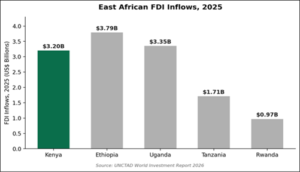
This explains why multinational brands increasingly view Kenya not merely as a sales market, but as a strategic long-term destination where flagship stores can protect pricing, customer experience, supply chains and brand integrity.
Protecting Original Brands
Global brands are valuable because consumers associate them with quality, reliability, and trust. That reputation depends on robust intellectual property protection. A trademark is not merely a logo; it embodies years of investment, innovation, and consumer confidence.
Kenya has made notable progress, although counterfeit trade remains a persistent economic challenge.
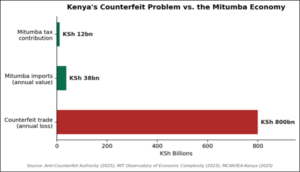
According to the Anti-Counterfeit Authority, counterfeit trade costs Kenya an estimated KSh800 billion annually, close to 9% of GDP, and contributes to about 44,000 job losses every year. Illicit goods affect sectors from fashion and pharmaceuticals to electronics, spare parts, agrochemicals, and cosmetics.
Counterfeiting erodes tax revenues, undermines legitimate enterprise, discourages innovation and weakens investor confidence. The official arrival of Nike, Adidas and Hugo Boss stores is therefore a vote of confidence, but one that depends on stronger enforcement against illicit trade.
The Mitumba Dilemma
Any discussion about authenticity in Kenya must also confront mitumba. Unlike counterfeit goods, second-hand clothing is lawful. For millions of households, it provides affordable clothing, while supporting importers, wholesalers, transporters, market traders, and informal retailers.
Industry estimates suggest Kenya imported about USD 298 million worth of used clothing in 2023, making it Africa’s largest importer of second-hand apparel. The trade supports close to two million livelihoods and contributes approximately KSh12 billion annually in tax revenues.
This creates a delicate policy balance. Restricting mitumba may support local textile manufacturing, but abrupt limits would hurt households and informal businesses. The challenge is to strengthen domestic production while preserving affordability and livelihoods.
Building Kenyan Originals
If global brands’ return reflects confidence in Kenya’s consumer market, the next question is whether the country can become a producer of globally competitive brands, rather than only a destination for them.
Rivatex illustrates both the opportunity and the challenge. Despite more than KSh5 billion in government support, the textile manufacturer has faced high electricity costs, inadequate cotton production and persistent losses, prompting Government to seek private sector participation.
Intellectual property protection benefits not only multinationals but also Kenyan innovators. Designers, software developers, pharmaceutical companies, musicians, filmmakers, publishers and digital creators all need effective IP systems to commercialize their work.
Countries that have moved towards innovation-led growth, including South Korea, Singapore and Rwanda, have treated intellectual property as part of industrial policy, technology transfer and competitiveness.
The Kenya Intellectual Property Bill, 2026

Parliament’s consideration of the Kenya Intellectual Property Bill, 2026, could therefore become one of the country’s most consequential economic reforms.
The Bill proposes consolidating the Industrial Property Act, the Copyright Act and the Anti-Counterfeit Act, while merging KIPI, KECOBO and the Anti-Counterfeit Authority into the Kenya Intellectual Property Authority (KIPA). KIPA would oversee registration, administration and enforcement of IP rights.
The proposal seeks to reduce duplication, improve coordination, and create greater certainty for investors and innovators. A single institution could accelerate decisions, simplify compliance, and strengthen enforcement. Legislation alone, however, will not be enough.
Effective protection will require resourced enforcement agencies, specialised judicial capacity, efficient border controls, consumer awareness and public-private collaboration. KIPA’s success will be measured by its ability to reduce counterfeiting, encourage innovation, and improve investor confidence.

The Next Competitive Advantage
Kenya has spent two decades positioning itself as East Africa’s financial, logistics and technology hub. The arrival of flagship stores from some of the world’s most recognisable brands suggests it is also becoming a trusted consumer market.
Maintaining that confidence will require more than modern malls and rising demand. It will require a policy environment where innovation is rewarded, legitimate enterprise competes fairly, and intellectual property rights are respected.
If implemented effectively, the Kenya Intellectual Property Bill, 2026, could strengthen competitiveness, attract higher-value investment and support Kenya’s transition towards a knowledge-based economy.
Ultimately, the launch of the originals should not be measured only by the number of flagship stores opening in Nairobi’s malls. Its real significance will lie in whether Kenya creates the conditions for entrepreneurs, designers, manufacturers and innovators to build brands that travel beyond its borders. The greatest success of IP reform will not be that Kenyans buy more authentic global brands. It will be that the world increasingly buys authentic Kenyan ones.