

Where Does E-Waste Actually Go?

Every new laptop, server or mobile phone that enters an office eventually becomes someone’s disposal problem. For businesses, the technology upgrade cycle is usually measured in productivity, cybersecurity and cost. Increasingly, however, it must also be measured in what happens to the equipment that is replaced.
Electronic waste, or e-waste, is among the world’s fastest-growing waste streams, driven by rapid technological change and increasingly short product lifecycles. For businesses, the challenge is no longer how to acquire technology efficiently, but how to manage it responsibly when its useful life ends.
The problem is substantial. Computers, monitors, printers, servers, routers, cables, batteries, and mobile phones contain a mixture of plastics, glass, and valuable metals, as well as substances that can be hazardous if handled improperly.
When obsolete equipment is discarded with ordinary office waste, it can end up in a landfill or informal disposal channels. Materials such as lead, mercury and cadmium can pose environmental and health risks, while valuable commodities including copper, aluminium, gold and silver are lost.
That is both an environmental problem and an economic one.
Proper recycling can turn discarded equipment into a source of secondary raw materials. Authorised recyclers dismantle devices and recover materials for use in manufacturing, reducing demand for virgin resources and, in some cases, the emissions associated with mining and processing them.
For companies, however, the economics of e-waste extend beyond recycling. Electronic equipment often contains commercially sensitive information. A discarded laptop or server can carry customer records, financial information, passwords or intellectual property long after it has stopped being useful to its owner.
Data destruction should therefore be treated as part of the asset-disposal process, rather than an afterthought. Businesses need clear procedures for securely erasing or destroying data before equipment leaves their control, while working with reputable recyclers can help address both information-security and environmental requirements.
Yet recycling is not necessarily the best first step.
The most sustainable computer is often the one that does not need replacing. Organisations can extend the life of equipment through repairs, upgrades and redeployment. A laptop that is no longer adequate for one department may still meet the needs of another. Such measures can reduce procurement costs, delay replacement cycles and prevent usable equipment from entering the waste stream prematurely.
This requires a shift in how businesses think about technology assets. Instead of viewing equipment simply as something to purchase, use and discard, companies can manage it as part of a lifecycle: buy, maintain, repair, redeploy and, finally, recycle.
Employees are central to making that system work. Faulty equipment should be reported rather than discarded; obsolete devices should be returned through approved channels; and batteries and small electronic accessories should be taken to designated collection points. Most importantly, replacement should be driven by genuine business need rather than habit.
For companies under growing pressure to demonstrate environmental, social and governance commitments, e-waste also offers a practical test of corporate sustainability. A sustainability strategy that addresses energy consumption and carbon emissions but ignores the physical lifecycle of technology is incomplete.
The opportunity is particularly significant as businesses become more dependent on digital infrastructure. More devices, more frequent upgrades and expanding data requirements will inevitably generate more obsolete equipment.
The question is what happens next.
A retired laptop can become hazardous waste, a security liability or a source of valuable materials. The outcome depends on the systems a business implements before the device leaves the office.
The digital economy may be powered by technology, but its sustainability will increasingly depend on what businesses do with that technology when the power is switched off.
The Global E-waste Monitor 2024, published by the International Telecommunication Union (ITU) and the United Nations Institute for Training and Research (UNITAR) indicates:
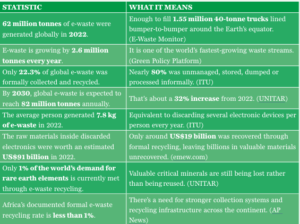
Electronic waste is one of the world’s fastest-growing waste streams, yet many of the materials in office electronics, including copper, aluminium, gold and silver, can be recovered and used to manufacture new products. Responsible recycling helps keep these valuable resources in circulation instead of sending them to landfills. Let’s all strive to be part of positive change.