

How Breast Cancer Awareness Month Turns Communication into Action

Pink October is Breast Cancer Awareness Month. It also promotes early detection.
According to the National Breast Cancer Foundation, Breast Cancer Awareness Month (BCAM) began in October 1985 as an American Cancer Society-led campaign. In 1992, the pink ribbon became a widely recognised symbol of breast cancer awareness and fundraising. Since then, the campaign has grown into a global movement. But what does an awareness month actually achieve? Its impact lies in the conversations it sparks, the knowledge it shares, and, most importantly, the actions it inspires.
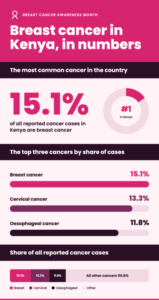
According to the National Cancer Registry of Kenya (NaCaRe-KE), breast cancer is the most common cancer in Kenya, accounting for 15.1% of reported cases, followed by cervical cancer (13.3%) and oesophageal cancer (11.8%).
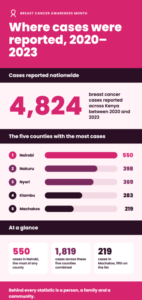
Between 2020 and 2023, 4,824 breast cancer cases were reported nationwide. Nairobi recorded the most, with 550 cases, followed by Nakuru (398) and Nyeri (369). Kiambu recorded 283 cases, while Machakos reported 219.
Behind every statistic is a person, a family and a community whose lives may never be the same. Many of us know someone who has battled cancer, cared for a loved one undergoing treatment or lost someone to the disease. These experiences remind us that cancer is not merely a statistic; it is a deeply personal reality that affects individuals, families and communities.
Late diagnosis makes this conversation even more urgent. Awareness is essential to help people recognise changes in their bodies, seek medical advice promptly, and understand the screening and diagnostic services available to them. Early detection can improve the chances of successful treatment, although awareness must go hand in hand with access to timely, appropriate and affordable healthcare.
I believe we all have a role to play in keeping these conversations going. Effective communication depends on translating an important message into something relatable that inspires action. Through storytelling, challenging perceptions and finding creative ways to capture attention, we can bring critical issues to the forefront and encourage meaningful change.
One initiative that caught my attention this October is Hermosa Paints’ pink zebra crossing near City Hall in Nairobi, part of the “Mapema Ndiyo Breast” campaign. By placing the message in a familiar public space, the campaign offers a creative and visible reminder of the importance of early detection. It demonstrates how public spaces and everyday experiences can become platforms for meaningful conversations. That is the power of creativity: it can take a message beyond posters and social media posts and bring it directly into people’s everyday lives.
This is also where sustainability comes in. Beyond environmental conservation, sustainability is fundamentally about people, their well-being and the future of our communities. Promoting health awareness and supporting those affected by breast cancer are integral to building healthier, better-informed and more resilient communities.
On Friday, 23 October, I will be wearing pink in solidarity with breast cancer warriors and survivors, their families, and everyone whose life has been touched by the disease. I invite you to join me. Wear pink, share credible information, encourage someone to seek medical advice or support an initiative that improves access to breast health services. Together, let us turn awareness into action and help build a future where more people can access early diagnosis, appropriate care, and the support they need.