

Watching the Vote: Citizens’ Vigilance Offers IEBC a Chance to Rebuild Trust

When the Ol Kalou Constituency in Nyandarua County cast its ballots in the July 16 parliamentary by-election, the exercise did not end at the polling station. Instead of returning to their daily routines, many stayed outside the polling stations, insisting they were there to “guard the vote.” This has, perhaps, set the stage for the 2027 elections.
The scenes witnessed that day underscored a growing shift in voter behaviour. Rather than leaving the electoral process to officials and party agents, some voters saw themselves as active custodians of the vote until the final results were announced. They said they wanted to deter electoral malpractice and ensure every ballot was accurately counted and transmitted.
Throughout the day, alleged attempts at voter bribery or intimidation were met with vigilance from residents. The heightened public vigilance reflected not only increased civic engagement but also a deepening trust deficit in Kenya’s electoral process, shaped by previous disputed elections, allegations of voter manipulation, and protracted court battles. Party supporters also launched independent vote-verification initiatives, live-streaming results from polling stations as counting progressed.
The desire to safeguard election results independently extended beyond the polling stations. Software developer Daniel Miringa used the by-election to test his digital vote-tallying platform, “People’s IEBC”, as part of preparations for the 2027 General Election. The platform verified and tallied results from 93 of the 144 Form 35A returns, enabling agents to upload photographs of official results forms for real-time verification.
Together, these developments reflect a growing desire among citizens to independently verify election results rather than rely solely on the Independent Electoral and Boundaries Commission (IEBC)’s official declarations. At the same time, perceived inaction over electoral malpractice continues to erode public confidence in the electoral body.
According to the Law
Kenya’s electoral laws require voters to leave the polling station and its immediate precincts immediately after casting their ballots to allow others to vote and to maintain order and security.
The law also provides that each political party or candidate is entitled to only one agent at each polling station and one chief agent at each tallying centre. It does not recognise “super agents” or permit unauthorised persons to operate within polling or tallying centres.
State and public officers who are registered voters may cast their ballots only at their designated polling stations and are prohibited from moving between polling stations. In addition, no person may enter a polling station wearing clothing, badges, symbols or any other items that indicate support for a political party or candidate.
Article 81 of the Constitution requires elections to be free, fair, transparent, and reflective of the will of the people. Article 86 further requires that every vote be counted accurately, that election results be transparent and verifiable, and that the entire electoral process be protected against fraud and manipulation.
Confidence in the IEBC
In July 2025, IEBC Chairperson Erastus Edung Ethekon and six commissioners – Ann Njeri Nderitu, Moses Alutalala Mukhwana, Mary Karen Sorobit, Hassan Noor Hassan, Francis Odhiambo Aduol and Fahima Araphat Abdallah – were sworn in.
Even as the IEBC team settles into the office, public confidence in the commission remains fragile.
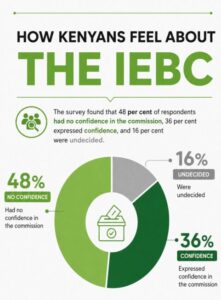
The Trends and Insights for Africa (TIFA) survey, conducted between 23 August and 3 September 2025, found that nearly half of Kenyans doubt the IEBC’s ability to deliver free and fair elections in 2027.
The survey found that 48 per cent of respondents had no confidence in the commission, 36 per cent expressed confidence, and 16 per cent were undecided. TIFA interviewed 2,024 respondents by telephone in Kiswahili and English, after initially recruiting participants through household-based face-to-face interviews. The survey covered nine regions: Central Rift, Coast, Lower Eastern, Mt Kenya, Nairobi, Northern, Nyanza, South Rift and Western – and had a margin of error of +2.17 percentage points.
As it prepares for the 2027 General Election, the IEBC is working to rebuild public trust after criticism of its handling of previous elections. The commission is collaborating with the National Police Service (NPS) and the National Cohesion and Integration Commission (NCIC) to tackle electoral offences and to hold those responsible for incitement and political violence to account.
The events witnessed in Ol Kalou suggest that Kenyans are no longer content to cast their ballots and leave. Increasingly, they want to witness, verify and safeguard the integrity of the vote until the final result is declared.