

The State of Openness Report: Can Transparency Finally Become Measurable?

On 16 July 2026, President William Ruto commissioned the development of Kenya’s inaugural State of Openness Report, marking one of the most consequential governance reforms undertaken by the Kenya Kwanza administration. While governments routinely pledge transparency, few voluntarily establish a mechanism through which their own openness will be independently assessed. By directing the Commission on Administrative Justice (CAJ) to produce an annual national assessment of openness across public institutions, the Government is signalling a deliberate shift from political commitment to measurable governance. More importantly, it is introducing an institutional framework through which openness can be evaluated, benchmarked and progressively improved.
The policy significance, however, lies less in the report itself than in what it seeks to institutionalise. If implemented with credibility and independence, the initiative has the potential to transform transparency from an abstract constitutional principle into a measurable indicator of public sector performance. In doing so, it would fundamentally change how government accountability is assessed in Kenya, moving the conversation beyond declarations of openness to evidence of institutional performance.
Transparency Is No Longer About Disclosure Alone
Globally, public sector transparency has evolved considerably over the past two decades. Early reforms centred on Freedom of Information laws, open data portals and proactive disclosure of government information. Countries such as Sweden, Canada and the United Kingdom demonstrated that access to information strengthens democratic accountability. More recently, however, governance frameworks under initiatives such as the Open Government Partnership (OGP) have shifted attention towards a more fundamental question: whether openness actually improves governance outcomes rather than simply increasing the volume of information available to citizens.
Kenya’s proposed framework reflects this evolution. Rather than limiting the assessment to compliance with access-to-information obligations, the report is intended to examine whether openness improves public service delivery, strengthens stewardship of public resources, enhances institutional responsiveness and ultimately delivers better outcomes for citizens. Consequently, the emphasis moves beyond procedural compliance to evaluating whether transparency is producing tangible improvements in governance.
This distinction is significant as governments can comply with disclosure requirements while remaining opaque in decision-making and service delivery. By focusing on outcomes rather than processes, Kenya is aligning itself with emerging international thinking that measures the effectiveness of open government rather than the mere existence of transparency mechanisms.
A Missing Link in Kenya’s Accountability Architecture
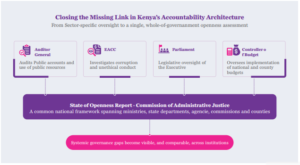
Kenya already possesses a robust accountability architecture. The Constitution guarantees access to information under Article 35, while Article 10 entrenches transparency and accountability among the country’s national values. In addition, institutions such as the Office of the Auditor-General, the Ethics and Anti-Corruption Commission, Parliament and the Controller of Budget each perform distinct oversight functions within the governance ecosystem.
However, these institutions largely operate within sector-specific mandates, examining particular aspects of accountability rather than providing an integrated assessment of government openness. The proposed State of Openness Report seeks to fill that gap by introducing a whole-of-government governance assessment that measures institutional performance across ministries, State departments, agencies, constitutional commissions and county governments using a common national framework.
From a public policy perspective, this is perhaps the initiative’s most significant innovation. Rather than creating another oversight institution, it seeks to connect existing accountability mechanisms within a single performance framework. Such an approach enables policymakers to identify systemic governance gaps, benchmark institutional performance over time and target reforms where they are likely to have the greatest impact.
International Comparisons Suggest the Real Test Lies Ahead
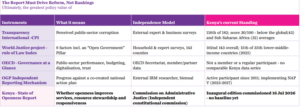
Comparable governance assessments already exist internationally. The OECD’s Government at a Glance, Transparency International’s Corruption Perceptions Index, the World Justice Project’s Rule of Law Index and the Open Government Partnership’s Independent Reporting Mechanism all evaluate different dimensions of openness, accountability and institutional performance. Collectively, these frameworks demonstrate that transparency becomes meaningful only when governments are willing to subject themselves to objective and independent assessment.
Their experience also points to one consistent lesson: credibility depends less on political endorsement than on methodological independence. Recognising this, President Ruto emphasised that the report’s methodology, evidence base, stakeholder consultations and findings must all be transparent, inclusive and independent.
Consequently, the long-term legitimacy of Kenya’s State of Openness Report will depend on whether the Commission on Administrative Justice is able to preserve that independence, particularly where its findings expose institutional weaknesses or uncomfortable truths. If that standard is maintained, the report could evolve into the country’s definitive governance benchmark rather than another periodic government publication.
The launch therefore represents more than a transparency initiative. Rather, it marks the beginning of a broader shift in Kenya’s governance architecture, one that seeks to replace promises of openness with measurable evidence of institutional performance.
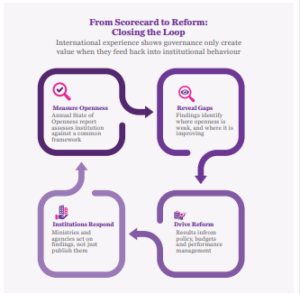
Whether that ambition succeeds will ultimately depend not on the publication of the report itself, but on the willingness of public institutions to embrace its findings, address identified shortcomings and demonstrate that openness can indeed translate into better government.