

The Stakes for East Africa: Inside Dangote’s Lamu Refinery
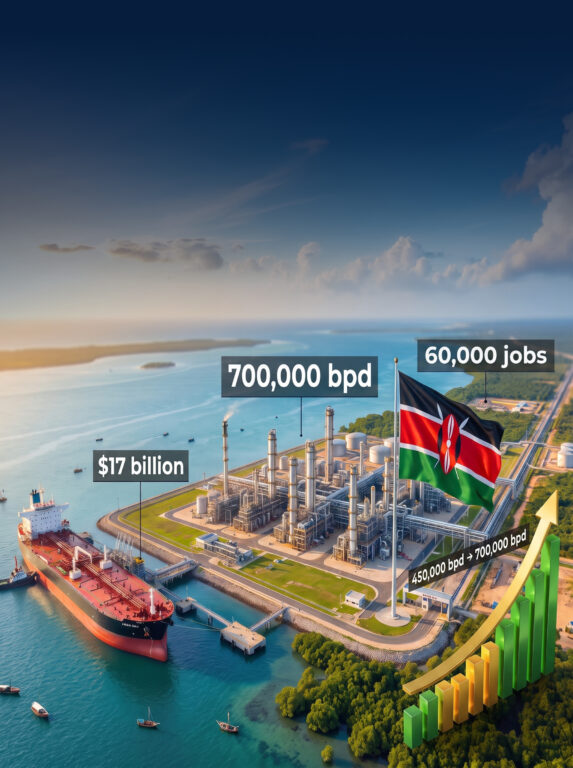
The construction of the proposed 700,000-barrel-per-day oil refinery in Lamu County, Kenya, is expected to begin before the end of the year, with the facility projected to create about 60,000 jobs.
The KSh2.2 trillion refinery will be Kenya’s largest private-sector investment and Dangote’s second refinery after the 650,000-barrel-per-day Lekki facility in Nigeria. The Nigerian facility cost more than US$ 20 billion and began operations in January 2024.
Forbes ranks Aliko Dangote as Africa’s richest man, with an estimated net worth between US$31 billion (KSh4.01 trillion) and US$35 billion (KSh4.52 trillion). His business empire spans cement, sugar and salt production, as well as car and truck assembly plants in more than a dozen African countries.
On August 4, Reuters reported that Dangote Oil Refinery is set for Africa’s biggest-ever market listing as it seeks to raise about US$5 billion (KSh646.9 billion) through an initial public offering (IPO) expected to conclude in October.
Dangote plans to raise funds to expand the capacity of the 650,000-barrel-per-day Lagos-based refinery and replicate its success with a similar facility in Lamu, Kenya.
The planned IPO, whose proposed timeline is fairly tight according to the source, has attracted interest across the continent. Reuters reported that stock exchanges in South Africa, Kenya, Egypt, Ghana and Rwanda have held a series of meetings with the refinery’s advisers in recent months to take part in the deal.
Kenya’s capital markets could raise as much as US$500 million (KSh64.69 billion) toward the Dangote IPO target, with “tremendous” appetite for the issue among local investors, such as pension funds.
A second source with direct knowledge of the deal informed the news agency that Dangote Petroleum Refinery & Petrochemicals FZE, which has submitted its IPO application to Nigeria’s Securities and Exchange Commission, is expected to receive approval in the coming weeks and publish a prospectus in September.
The first source said the IPO’s target was US$5 billion (KSh646.9 billion) but cautioned that the final figure would depend on what the Nigerian regulator approves, as the primary listing will be on the Nigerian Stock Exchange. That target would account for just over 4 per cent of Nigeria’s main All Share Index, whose total capitalisation stood at US$ 116 billion (KSh15.0 trillion) on August 4.
Other capital markets on the continent that want a slice of the deal will have to craft “structured solutions” for their investors, such as global depository receipts or exchange-traded instruments that mirror the actual shares to be listed on the Nigerian exchange, including the right to accrue future dividends. A cross-listing, or dual listing, of the shares in other regional markets is not planned at this stage, the source disclosed to Reuters.
Aliko Dangote, 69, is keen for the IPO to be a pan-African venture, in line with his vision of helping the continent find local solutions for its development challenges.
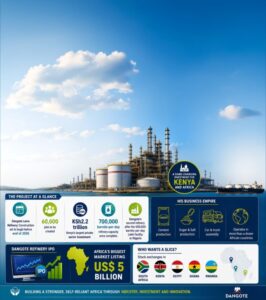
Who wants a slice?
- Stock exchanges in South Africa, Kenya, Egypt, Ghana, and Rwanda
The Lamu Archipelago
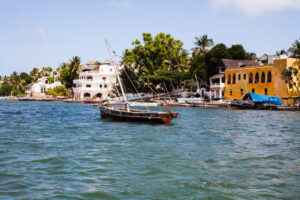
The Lamu archipelago, a United Nations Educational, Scientific and Cultural Organisation (UNESCO) World Heritage Site, hosts the Lamu Port, the first component of the LAPSSET Corridor project.
The port is planned to have 23 berths, with three already operational, featuring a draft of 17.5 metres and a turning basin of 500 metres. Details from the Lamu Port-South Sudan-Ethiopia-Transport Corridor (LAPSSET) Corridor Development Authority indicate that Phase Two of the port will include a liquid bulk terminal and an agri-bulk terminal to meet the projected regional demand of 70 million tonnes of agricultural bulk cargo by 2045, and Kenya’s estimated refined petroleum demand of 16.3 million tonnes.
The port currently handles transhipment cargo destined for the United Arab Emirates (UAE), Mozambique, Tanzania, Zanzibar, Comoros, and Madagascar, including containerised cargo, bulk goods and motor vehicles.
Additionally, the Kenyan government is pursuing a landlord model for some port operations to enhance efficiency and competitiveness. The Lamu Port Container Terminal berths and the Lamu Special Economic Zone are earmarked for development and operation through Public-Private Partnerships (PPPs).
The LAPSSET Corridor project includes highways linking Lamu to Isiolo, Isiolo to Juba in South Sudan, Isiolo to Addis Ababa in Ethiopia, and Lamu to Garsen, alongside the establishment of a Special Economic Zone.
Other flagship components include a crude oil pipeline from South Sudan through the Lokichar oil fields to Lamu, a refined products pipeline from Lamu to Ethiopia via Isiolo and Moyale, and a 3,000-kilometre single-track Standard Gauge Railway (SGR) linking Lamu Port to Juba and Addis Ababa.
To strengthen regional connectivity, the government is fast-tracking the multinational Bagamoyo-Tanga-Horohoro/Lunga Lunga-Malindi Road project. The KSh15 billion project, jointly financed by the African Development Bank (AfDB), the European Union and the Government of Kenya, is divided into two sections. Lot One, covering the Nyali Bridge-Mtwapa Bridge stretch, is 56 per cent complete, having begun in November 2022 and is expected to be completed by August 2027.
Lot Two is covering the Mtwapa kwa Kadzengo-kilifi section, which is 76 per cent complete despite earlier delays caused by land acquisition challenges.
Environmental Concerns
The project has drawn strong opposition from environmental groups, which argue that the refinery could damage Lamu’s fragile ecosystem while locking the country into long-term fossil fuel dependence.
Environmentalists contend that promises of job creation should be weighed against potential risks to the country’s fishing, tourism and local economies. They also warn that oil spills from tankers, pipelines, storage facilities or refinery operations could severely impact Lamu’s mangrove forests, coral reefs and marine habitats that support thousands of artisanal fishers.
They have called for a more comprehensive environmental impact assessment and broader public participation before the project advances, with some indicating they are prepared to challenge approvals in court if their concerns are not addressed.
The resistance highlights a broader challenge confronting large industrial investment across the continent. Although financing and engineering remain critical, securing community support, meeting environmental standards, and navigating regulatory approvals have become equally important for ensuring projects are delivered as planned.
Liquid Gold
Africa, despite having sizeable crude reserves, refines only about 44 per cent of the total oil it consumes. Imports make up the rest, according to a 2022 African Union report.
The top producers of refined oil are Algeria, Egypt and South Africa. There are about 21 refineries in North Africa. Southern Africa has another seven, while West Africa has 14. However, most refineries in Southern Africa and West Africa are either not operating or producing below their capacity.
East Africa’s only existing refinery is in Mombasa, but it halted operations in 2013 due to slow government policies and investors who deemed it commercially unviable. There is currently no refining capacity at all in East Africa, despite the region having about 4.7 billion barrels of crude reserves, according to the African Union, mainly in Kenya, Uganda, South Sudan and the Democratic Republic of Congo (DRC). In 2025, Kenya imported 40 million barrels of petroleum. Nigeria is Africa’s biggest net crude provider, with a capacity of 1.5 to 1.6 million barrels per day.
What it Means for Locally Refined Crude Oil
The continent exports most of its crude oil and then imports refined products. More oil refined on the continent would mean lower petrol pump prices, lower transport costs, and more energy available for people and businesses. In addition, it would mean greater access to by-products such as fertilisers for farmers and petrochemicals for manufacturers.
Across Africa
While Algeria, Egypt and South Africa remain Africa’s leading refined petroleum producers, other countries are also investing heavily in domestic refining capacity. Angola and Uganda are among the latest.
A few months ago, Angola’s US$470 million Cabinda Refinery began supplying both domestic and export markets. The project, primarily owned by the United Kingdom’s Gemcorp Capital, has an initial refining capacity of 30,000 barrels per day, with plans to double output by the end of the year.
In Uganda, a government-backed refinery in the Hoima region is expected to begin operations in 2029. The refinery will have a capacity of 60,000 barrels per day and will process crude transported through the Uganda-Tanzania East African Crude Oil Pipeline (EACOP). The facility is expected to produce diesel, jet fuel, kerosene and liquefied petroleum gas (LPG).