

From Meme to Lifesaver: How Students Created a Digital ‘Purple Book’ to Reduce Maternal Deaths
The purple book, officially known as the ‘Mother and Child Health Handbook’, has become an unlikely social media star, attracting millions of views through humorous memes and videos. The joke usually begins with a woman visiting a hospital for a routine check-up, convinced she has diagnosed herself after searching her symptoms online. Instead of receiving the prognosis she expects, she leaves with the unmistakable purple book – a sign that clinical tests have confirmed she is pregnant.
Beyond the memes, however, the purple book is a vital maternal health record. It documents a woman’s pregnancy journey from her first antenatal visit through to childbirth and continues until her child has received all the recommended vaccinations. It has played an important role in ensuring that antenatal and postnatal care records are properly maintained.
When five university students learnt about the handbook, they saw an opportunity to improve it. They envisioned a digital version that would be more interactive and, more importantly, help ensure mothers receive timely care whenever pregnancy-related complications arise.
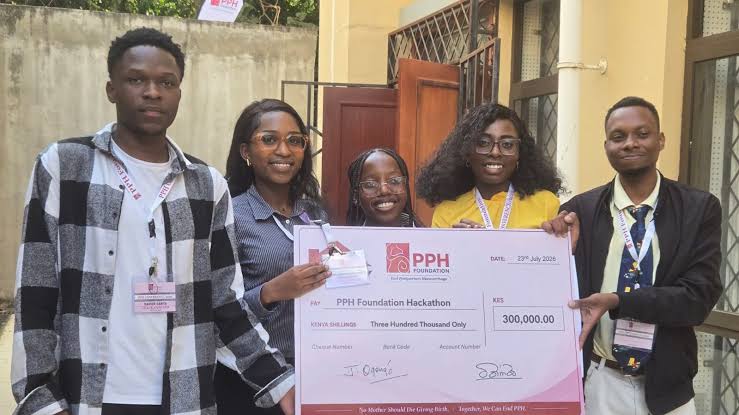
Their idea came to life at the first hackathon held during the recently concluded inaugural Post-Partum Haemorrhage Conference in Nairobi, where their team, MamanaMtoto+, emerged as the winners.
“We are so excited to take home this award as the first-ever recipients,” said Tanya K’Opiyo, the project’s team lead.
Tanya and her teammates are Medical Biochemistry students at the Jomo Kenyatta University of Agriculture and Technology (JKUAT), with one team member due to join nursing school in September.
Mark Njeru, the research lead for MamanaMtoto+, said the project began with a simple question: What challenges do mothers face during pregnancy, childbirth, and the postnatal period?
“I found that the purple book works well during clinic visits. But once the mother leaves the health facility, routine follow-up becomes difficult. A community health volunteer may not know when a mother is experiencing problems because they are not always with her,” he explained.
To better understand these challenges, the team visited a health facility in Kitengela, where they interviewed expectant mothers who use the handbook. They also distributed questionnaires to nurses and community health volunteers to gain insights into their experiences with the book.
After analysing the data, they found that while the purple book works effectively within health facilities, it becomes little more than a document mothers carry to clinic appointments once they return home.
At the hackathon, held at the Confucius Institute of the University of Nairobi, the team had just 15 minutes to convince the judges that their solution deserved the KSh300,000 cash prize to help scale the project. They succeeded.
Tanya said that the team’s mobile app is designed to become a comprehensive maternal healthcare companion, supporting mothers and their babies well beyond pregnancy. The vision aligns with the Every Woman, Every Newborn, Everywhere (EWENE) initiative, which is supported by the Ministry of Health and seeks to reduce maternal and newborn deaths.
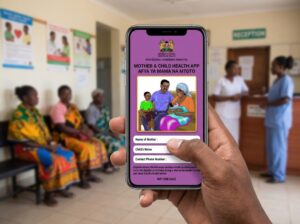 She noted that although the purple book contains valuable information, physical records can easily be damaged or lost.
Their app, together with a USSD service for mothers without internet access or those using feature phones, will store records digitally, send reminders for antenatal appointments, issue alerts and provide guidance during health emergencies.
“As the world becomes increasingly digital, our application aims to capture warning signs from the very beginning,” Tanya said.
Once a woman receives a positive pregnancy test, a clinician will advise her to download the app and register her details, she explained. From then on, she will be guided through recording even the slightest symptoms.
The app also caters for adolescent mothers, who, studies show, often face stigma when seeking maternal healthcare and may miss clinic appointments as a result.
To address this, the platform features an anonymous chatbot that connects mothers with clinicians who can answer pregnancy-related questions privately. It also includes educational resources tailored for first-time adolescent mothers, helping to reduce stigma by providing confidential support.
“Our application will help mothers identify complications much earlier than they ordinarily would,” Tanya added.
The system continues to support mothers after delivery by sending reminders when their children are due for routine vaccinations.
Xavier Sanya, a third-year Medical Biochemistry student, explained that when a mother reports a danger sign, such as heavy bleeding, an alert is sent instantly to a clinician through a real-time dashboard. At the same time, the mother’s partner receives an SMS notification.
“All this happens in under three seconds, and this is the kind of innovation that could save mothers’ lives,” Xavier said.
Following their KSh300,000 win, the team plans to develop the platform further. Their priority is designing the back-end system, which will manage how alerts are routed from mothers to community health volunteers. The system will also store patient profiles and integrate with the Kenya Health Information System (KHIS).
For the pilot phase, the team will build a Minimum Viable Product (MVP) – the simplest version of the app capable of solving the core problem. It will be available in both English and Kiswahili to reach a wider audience.
Tasha K’Opiyo, the team’s Community Health Lead and an incoming nursing student, said they plan to introduce the app through antenatal care clinics while raising awareness in local communities about its benefits.
Faith Mutanu, a third-year JKUAT student and the team’s Business and Sustainability Lead, said the pilot will begin in Kiambu County before expanding to Garissa and Kisumu counties. In the final phase, the team hopes to roll out the application across more counties and secure endorsement from the Ministry of Health. They aim to achieve this within a year.
(Source: Daily Nation)