

The Neuroscience of Workplace Burnout: Why Managing Occupational Stress is an Operational Risk, not a Soft HR Issue

For years, workplace stress and employee burnout have been treated as personal wellness failures or addressed with surface-level perks such as subscription-based mindfulness apps and casual Friday initiatives. In today’s high-pressure commercial and institutional environment, defined by continuous digital connectivity, lean operating structures, and accelerating output targets, this legacy approach is a costly oversight.
Managing occupational stress across organisational tiers is a priority in operational risk management. When chronic stress pervades a workforce, it impairs the primary engine of enterprise value: collective decision-making, operational agility, and the quality of daily execution.
The Neurobiology of Organisational Stress
To build resilient work structures, organisations must understand how sustained pressure affects cognitive mechanics across operating teams:
- Prefrontal Cortex Fatigue: The prefrontal cortex (PFC) governs executive functioning across all roles, including complex problem-solving, strategic planning, error detection, and emotional regulation. Prolonged exposure to high cortisol and adrenaline levels weakens PFC neural connectivity, reducing focus and increasing error rates in daily operations.
- Amygdala Hyper-Reactivity: Under chronic pressure, the brain’s threat-detection centre (the amygdala) becomes hyperactive. Teams operating in a state of continuous alarm default to defensive, short-term, reactive behaviour, escalating workplace friction and stalling cross-functional collaboration.
- Loss of Cognitive Flexibility: Prolonged exhaustion degrades working memory and adaptive thinking, preventing teams from effectively navigating sudden operational changes, regulatory shifts, or crisis scenarios.
Quantifying the Enterprise Risk
Treating burnout strictly as a personal health challenge overlooks its measurable impact on institutional performance and operational stability:
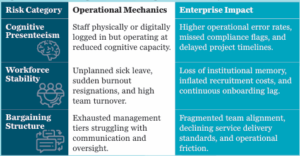
Structural Design vs. Surface Wellness
A common pitfall in corporate health strategy is trying to solve structural workflow problems with individual wellness tools. Offering meditation apps or wellness seminars to teams operating under unrealistic output metrics, with unintegrated digital tools and constant connectivity, does not solve burnout.
Effective stress mitigation requires structural workflow management:
- Mitigating “Technostress”: Enforce clear communication protocols and digital boundaries to reduce the fatigue of constant multitasking and protect uninterrupted focus time.
- Aligning Accountability with Capacity: Ensure teams held responsible for ambitious key performance indicators (KPIs) have adequate operational resources, clear processes, and clear decision-making authority.
- Structuring Recovery Windows: Integrate realistic project buffer times and recovery cycles into workflow design, treating rest as essential operational maintenance to sustain high-quality output.
An Operational Framework for Workplace Health
To protect human capital and preserve operational delivery standards, leadership and HR operations should integrate stress governance into the broader enterprise risk management:
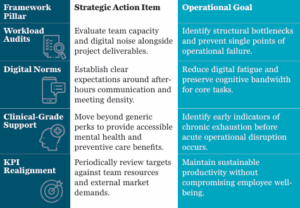
Protecting Operational Capacity
Workplace health is an operational imperative. At every level of an organisation, cognitive bandwidth drives execution and value creation. By treating burnout as an operational risk and applying structural, evidence-based solutions, organisations protect performance, safeguard institutional knowledge, and build resilient workforces that can navigate complex economic environments.