
How Political Uncertainty Could Shape Kenya’s Economy Ahead of 2027 Polls
The year before a general election in Kenya is usually characterised by intense campaigning, with greater focus on political activities often unrelated to the country’s real policy challenges.
During this period, uncertainty rises; businesses and investors may adopt a cautious approach, delay investment, and postpone decisions until the political and economic environment becomes clearer.
From previous experience, campaign periods show that elections affect various economic activities, including financial markets. During these periods, there are spikes in public spending, some lawful, some questionable, and others outright unlawful. For instance, in 2022, just days before the general election, the Controller of Budget disclosed that she had been pressured to authorise KSh15.5 billion in questionable expenditure.
In her testimony before the Parliamentary Public Petitions Committee, she presented WhatsApp messages from the then-Cabinet Secretary for Treasury, demonstrating the political pressure applied. When asked why she did not decline, she responded, “It is not a black and white, yes or no situation”, underscoring how political dynamics can override legal procedures in high-stakes political moments.
In another 2017 scenario, the Jubilee government accelerated the Last Mile Connectivity Project, expanding electricity access in rural constituencies just months before the election. Although framed as inclusive development, the timing and location of these rollouts closely aligned with competitive electoral areas.
Economic Performance
The economic performance during this period is usually mixed, with the impact of elections largely dependent on the extent of political disruption and the prevailing macroeconomic conditions.
During the 2007/08 election period, real Gross Domestic Product (GDP) growth fell to 0.2 per cent in 2008, down from 6.9 per cent in 2007, following post-election violence that disrupted economic activity across key sectors.
In 2017, growth moderated to 3.8 per cent from 4.2 per cent in 2016, mainly due to prolonged electioneering uncertainty and adverse weather conditions. During the 2013 election period, growth fell to 3.8 per cent from 4.6 per cent in 2012. The 2022 slowdown, from 7.6 per cent to 4.9 per cent, was less conclusive as an election effect, given the unusually strong post-COVID rebound in 2021 and the severe drought in 2022.
For this year, analysts say the country is entering the 2027 election cycle from a relatively stronger growth position. Real GDP expanded by 5.3 per cent in Q1’ 2026, up from 4.9 per cent in Q1’ 2025, supported by broad-based growth across construction, financial services, manufacturing and agriculture. They say this provides a more favourable starting point ahead of the 2027 election, although the sustainability of growth will be more important than the headline rate for capital markets.
They state that continued economic expansion would support corporate earnings, government revenues and investor sentiment, whereas a broad-based slowdown during the electioneering period could weaken earnings expectations and heighten risk aversion.
The key risk ahead of 2027 is therefore not the election itself, but whether election-related uncertainty amplifies existing economic weaknesses, making the underlying growth environment an important determinant of the eventual impact on capital markets.
Private Sector and Business Activities
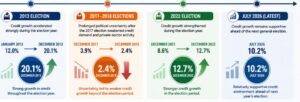
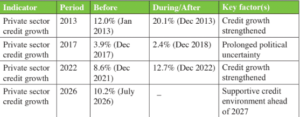
Private-sector credit growth varied across the election cycles. In 2013, credit growth rose to 20.1 per cent in December, up from 12.0 per cent in January. By contrast, credit growth stood at 3.9 per cent in December 2017 and fell to 2.4 per cent in December 2018, as prolonged political uncertainty following the 2017 election continued to weigh on credit demand and private-sector activity.
During the 2022 election period, private-sector credit growth strengthened to 12.7 per cent in December 2022, up from 8.6 per cent in December 2021.
As of July 2026, private-sector credit growth stood at 10.2 per cent, indicating a relatively supportive credit environment ahead of next year’s general election. However, the 2017–2018 experience highlights the risk that prolonged election-related uncertainty could weaken credit demand and private-sector activity beyond the election period if it persists.
According to Stanbic’s Purchasing Managers’ Index (PMI), business activity also weakened as the country approached the elections. In the 2017 election period, the PMI fell to 42.0 in August 2017 from 52.0 in December 2016, moving below the 50.0 threshold, which indicates a shift from expansion to contractionary territory.
Stanbic PMI
A simil
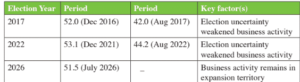
ar pattern was observed in 2022, with the PMI falling to 44.2 in August from 53.1 in December 2021, again moving from expansionary to contractionary territory. The PMI decline during both election periods suggests that prolonged election-related uncertainty can weigh on business activity, as firms delay investment and spending decisions.
In July 2026, the PMI stood at 51.5, remaining above the 50.0 threshold and signalling continued expansion in private-sector activity. However, the experience of the previous two election periods highlights the risk that prolonged election-related uncertainty could weaken private-sector activity if businesses adopt a wait-and-see approach ahead of next year’s polls.
Upcoming Polls
As we approach the 2027 polls, analysts say the country enters the period with a relatively resilient yet increasingly constrained investment environment. Real GDP growth remains positive, Foreign Direct Investment (FDI) has strengthened significantly, and continued investment in infrastructure and affordable housing should support economic activity and alternative investments.
However, higher government borrowing, rising prices, and potential political uncertainty could pose challenges for the economy.