

The Road to 2027: The Dates and Deadlines That Will Shape Kenya’s Next Election
Kenya has officially entered the road to the 2027 General Election. Although voters will not go to the polls until 10 August 2027, the electoral calendar is already running, with deadlines now taking effect for political parties, aspirants, public officers and the electoral commission. The publication of Gazette Notice No. 13497 on 20 August 2026 formally commenced the election period and brought the Electoral Code of Conduct and the Election Offences Act into force for the 2027 election. Simply put, the election is no longer a distant political event; it is now a sequence of dates, decisions and legal obligations.
The Electoral Countdown
The first stage is already underway.
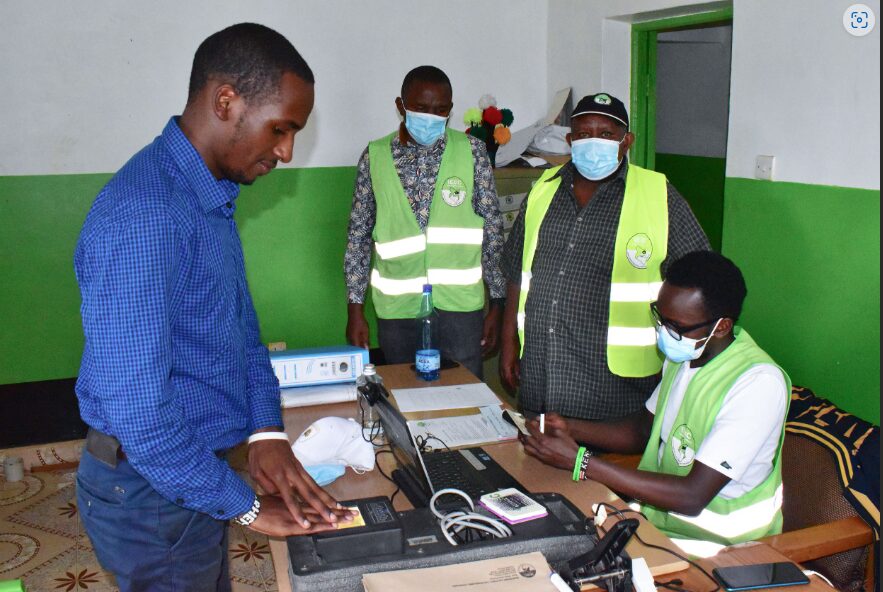
IEBC’s Continuous Voter Registration has been running since 29 September 2025, with eligible Kenyans able to register, transfer their registration and update their particulars. By 20 August 2026, 2,936,516 Kenyans had registered.
The Commission projects a voters’ register of approximately 28.5 million for 2027, compared with 22.1 million registered voters in 2022. Registration for Kenyans living outside the country is also being expanded from 12 to 26 countries.
The register will subsequently undergo an independent forensic audit and certification. Biometric technology is being used to allow voters to verify their information and assist in identifying deceased persons and duplicate registrations.


The Political Calendar: From Parties to the Ballot
For political parties, the election begins long before the campaign period.
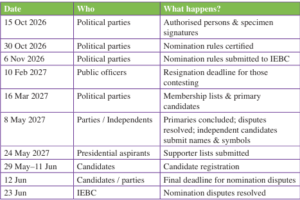
The first significant deadline is 15 October 2026, when parties must submit their authorised persons and specimen signatures to the Independent Electoral and Boundaries Commission (IEBC). Their nomination rules must be certified by the Registrar of Political Parties by 30 October and submitted to IEBC by 6 November.
The political machinery then moves into a more consequential phase. By 16 March 2027, parties must submit their membership lists as well as the names of candidates contesting party primaries, including the dates and venues of those primaries. All party primaries must be concluded, and intra-party disputes resolved, by 8 May 2027. Independent candidates must also submit their names and symbols by the same date.
For presidential aspirants, another threshold arrives on 24 May 2027. They must submit to IEBC the names, signatures and identification details of at least 2,000 registered voters in a majority of counties.
Candidate registration follows from 29 May to 11 June 2027, with different registration windows for presidential, parliamentary and county positions. Nomination disputes must be lodged within 24 hours of occurrence and, in any event, no later than 12 June, with IEBC required to resolve them by 23 June 2027.
[INFOGRAPHIC 2 — WHO MUST DO WHAT, AND BY WHEN?]
The Campaign, the Money and the Rules
Once candidates are registered, the contest enters its most visible phase.
The formal campaign period will commence upon registration of a candidate, but not earlier than 29 May 2027, and will end on 7 August 2027, being 48 hours before Election Day. Campaigning outside this prescribed period is unlawful, including the display of campaign posters, caravans, billboards and other forms of campaigning.
The rules governing political conduct are already active. The Electoral Code of Conduct provides for sanctions ranging from formal warnings and fines to restrictions on public media, public meetings, demonstrations, marches and campaign materials. Persistent or serious non-compliance can attract more severe sanctions.
The Election Offences Act separately criminalises conduct including bribery, violence, intimidation, multiple voting and interference with electoral processes.
Money will also be under scrutiny. IEBC gazetted the Election Campaign Financing Regulations 2026 and the contribution and spending limits for the 2027 General Election on 7 August 2026. Parties, candidates, campaign teams, donors and other regulated persons are subject to requirements covering contributions, expenditure, record-keeping, disclosure, reporting and accountability.
[INFOGRAPHIC 3 — THE 2027 CAMPAIGN: WHAT IS ALLOWED AND WHEN?]
CAMPAIGN WINDOW
29 MAY 2027 Campaign period opens → 29 MAY–7 AUGUST Campaigning under the Electoral Code of Conduct→7 AUGUST Campaigns close → 8–9 AUGUST 48-hour pre-election period →10 AUGUST POLLING DAY
IEBC Planning Behind the Scenes
While politicians prepare for the contest, IEBC is preparing the machinery that will deliver it.
The Commission says it has advertised the positions of Commission Secretary/CEO and seven directors, while continuing to fill vacancies and strengthen its staffing ahead of the election.
Procurement of election materials is also underway. However, procurement of election technology and ballot papers has temporarily been halted following a request for review before the Public Procurement Administrative Review Board. Other strategic and non-strategic procurement remains on course.
These developments may receive less public attention than political rallies and alliances, but they will ultimately matter just as much. An election is not delivered on polling day alone. It depends on the integrity of the register, the readiness of electoral officials, the availability of materials, functioning technology, clear rules and the ability of institutions to enforce those rules.
The Road Ahead
The 2027 General Election will therefore be shaped by a series of decisions long before voters enter polling stations. Parties must organise. Aspirants must qualify. Public officers must decide whether to resign. Candidates must navigate registration. Campaigns must operate within defined legal boundaries. Political money must be accounted for. IEBC must build and test the machinery of the election.
The Commission has also emphasised that election preparedness is a collective national undertaking involving government agencies, political parties, media, civil society, faith-based organisations, development partners and citizens.
For Kenyans, the most useful way to look at the coming year is therefore not simply to mark 10 August 2027 on the calendar. The more important question is what happens between now and then.