

Kenya’s Inflection Point: The 2025 State of the Nation and the Return of Ambition
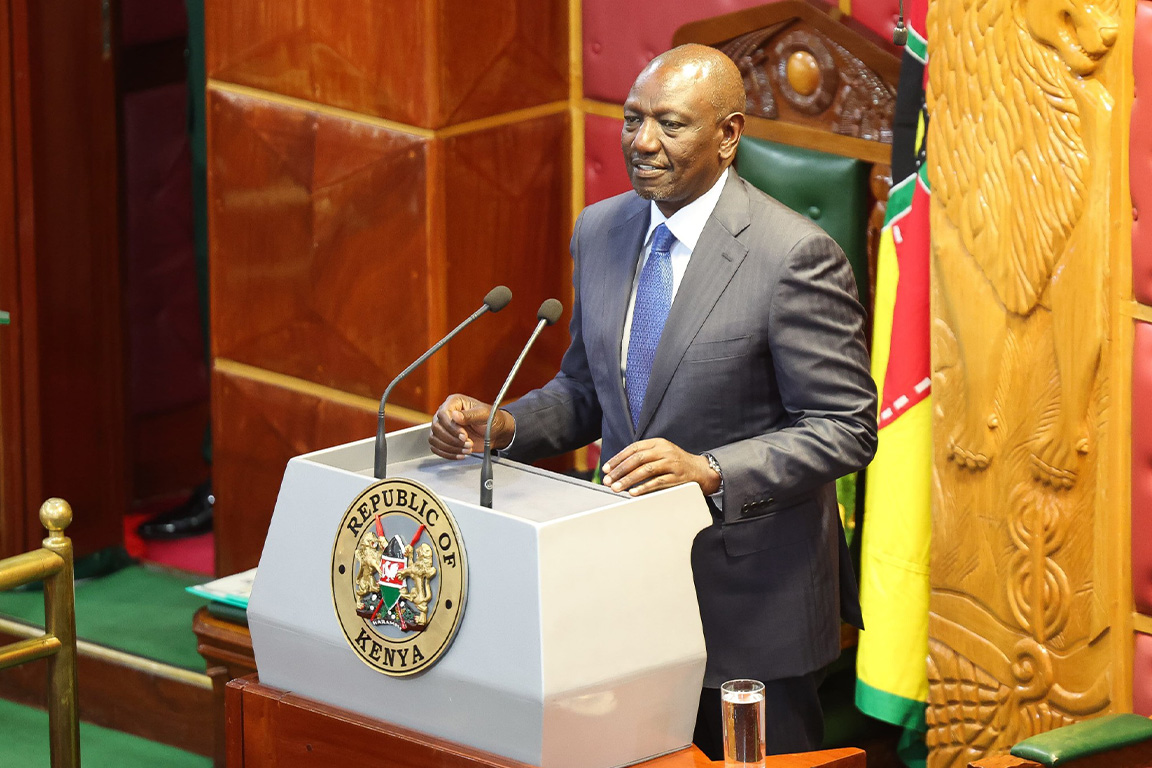
In his 2025 State of the Nation Address, President Ruto delivered more than a constitutional ritual; he attempted to reposition the national conversation from crisis management to long-horizon transformation. This year’s message carried a deliberate shift in posture: from defending past choices to challenging the country to expand its expectations. It was a narrative built on the argument that Kenya has stabilised after years of turbulence and is now poised for a generational pivot, if it embraces scale, discipline, and a recalibration of what ambition means for a developing state.
The speech opened by contrasting the anxiety of 2022 with the calmer macroeconomic landscape of 2025. It defined the administration’s first three years as a period of “repair and reset,” one in which inflation cooled to 4.6 per cent, the shilling held steady at 129 to the dollar, foreign reserves climbed past the USD 12 billion mark for the first time, and global confidence returned through an upgraded sovereign rating and a resurgent Nairobi Securities Exchange (NSE). Whether one credits fiscal consolidation, monetary tightening, or external conditions, the President used these indica-tors to argue that the country has pulled back from the brink and regained policy credibility.
Yet the core of the address did not dwell on stability. It hinged on production, particularly agriculture, as the foundation of cost-of-living relief and national resilience. The administration framed its agriculture reforms as structural rather than subsidy-driven, pointing to fertiliser distribution at scale, a farmer registry of more than seven million, and record maize harvests that pushed flour prices down to levels last seen years ago. The speech highlighted tea, coffee, edible oils, sugar, dairy, and livestock as value chains already responding to targeted interventions. In doing so, it sought to persuade Kenyans that the country’s food system is finally edging away from volatility and toward predictable, data-driven production.
The healthcare chapter of the address was equally ambitious, portraying the over-haul of NHIF into the Social Health Authority (SHA) as a historic redesign of the country’s health architecture. With 27 million Kenyans now enrolled and more than 100,000 Community Health Promoters (CHP) deployed nationwide, the administration framed Universal Health Coverage (UHC) as both a moral and economic necessity. The focus on primary healthcare, increased diagnostic reach, and reform at Kenya Medical Supplies Authority (KEMSA) positioned health as an investment in national productivity rather than a social expenditure.
Education received similar attention, with the President arguing that the shift to student-centred funding, aggressive teacher recruitment, and the rapid expansion of TVET capacity have begun restoring education as a true equaliser. This set the stage for a more consequential section of the speech: the assertion that Kenya must now treat human capital, research, science, and innovation as the engine of its next development chapter. The creation of a dedicated State Department for Science, Research, and Innovation, and the commitment to raise national research funding to two per cent of GDP, signaled an intention to pursue knowledge-based growth rather than rely solely on traditional sectors.
The address then moved into its most defining terrain: the four mega-priorities intend-ed to reorient Kenya’s long-term economic trajectory. The first was human capital; the second, a decisive shift from a net-importing to a net-exporting economy through large-scale irrigation and agro-industrialisation; the third, a 10,000-megawatt expansion in energy generation to underpin manufacturing, digital growth, and e-mobility; and the fourth, a transport and logistics network reimagined at the scale of a regional hub. The breadth of this vision was unmistakable and intentionally provocative, not merely in ambition but in its financing strategy.
To match this scale, the President introduced a fiscal architecture built around a National Infrastructure Fund (NIF) and a Sovereign Wealth Fund (SWF). Both instruments aim to ring-fence privatisation proceeds, crowd in private capital, and protect future generations from the consequences of today’s resource decisions. In doing so, the administration sought to signal a pivot away from debt-heavy development and to-ward a blended financing approach more aligned with global practice in fast-rising economies.
What emerged from the address was a deliberate attempt to recast the national narrative. The President invited the country to imagine itself not as a nation managing scarcity but as one engineering its transition to middle-income status with intent and scale. He invoked the Asian Tigers not as aspirational anecdotes but as reminders that development springs not from extraordinary circumstances but from sustained, disciplined investment and national coherence.
For Kenya’s policy and business community, the significance of this address lies in its clarity of direction. The next decade will be defined by infrastructure expansion, energy diversification, irrigation-led agriculture, agri-processing, digital-enabled growth, and large-scale human capital investment. It will require tighter public–private collaboration, deeper capital markets, more predictable regulation, and sharper execution across government.
Whether the country realises this ambition will depend less on the poetry of the vision and more on the discipline of implementation. But the signal sent to investors, development partners, and the private sector is unmistakable: the administration intends to pursue big bets. For clients and institutions across sectors, this is the moment to assess alignment, opportunity, and exposure, because the policy environment seems to be shifting from incrementalism to transformation.
In this sense, the 2025 State of the Nation Address was an inflection-point speech. It set out not only what the government believes it has achieved, but also what it expects the country and its economic actors to imagine possible. For a nation long ac-customed to constrained ambition, this year’s address challenged that comfort. It replaced it with something more demanding: a reminder that development is a choice, and that the window for that choice is open now.
Key Highlights from SOTN 2025
| Pillar | Highlights |
| Economic Stabilisation & Recovery | The President strongly emphasised macroeconomic turnaround, contrasting 2022’s crisis with 2025’s position of stability.
Key highlights:
He cast these as proof of “promises kept” and the outcome of fiscal consolidation, subsidy reform, and prudent monetary management. |
| Agriculture as the Centrepiece of Cost-of-Living Reforms | The speech reinforced the administration’s philosophy of subsidising production, not consumption, positioning agriculture as the backbone of growth.
Major outcomes:
|
| Universal Health Coverage Transformation | Described as the most far-reaching health reform since independence.
Key milestones:
|
| Education Reforms and Human Capital Investment | The President painted education as a pillar of equality and competitiveness.
Key achievements:
A new State Department for Science, Research & Innovation was created to push STEM and innovation. |
| Housing, Urban Regeneration & Job Creation | Housing was presented as both a social programme and an economic engine.
Highlights:
|
| MSME Empowerment & Youth Opportunity | A strong focus on financial inclusion and youth employment.
|
| Digital Transformation | Digital infrastructure and government digitisation were framed as core accelerators of opportunity.
|
| The New National Ambition: Four Mega Priorities | The President announced a bold, multi-decade national transformation blueprint.
1. Invest Heavily in People (Skills, Research & Innovation)
2. Shift Kenya to a Net Exporter (Food, Goods, Services)
3. Generate Additional 10,000 MW of Energy
4. Build World-Class Transport & Logistics
Estimated cost: KSh 5 trillion. |
| Financing the New Ambition: Two Funds | To avoid unsustainable debt, the President proposed a new fiscal architecture:
1. National Infrastructure Fund
2. Sovereign Wealth Fund To operationalise Article 201 on intergenerational equity:
This will be funded by natural resource royalties and privatisation revenues. |