

The KSh3.2M Question: Who Pays for Kenya’s Customs Loopholes?

A technical adjustment in customs administration has quickly escalated into a confrontation over the cost of doing business in Kenya. Following the Kenya Revenue Authority’s decision to raise the Customs Minimum Benchmark for general containerised consolidated cargo from KSh2.5 million to KSh3.2 million, traders have taken to the streets, businesses have closed, and the policy has taken on the familiar political character of a tax dispute.
Reducing the controversy to another confrontation between KRA and small traders, however, misses the more important question underlying it: how does the government tighten tax administration and protect public revenue without making legitimate businesses pay for the failures of the system it is trying to fix?
The KSh3.2M Figure is Not the Tax
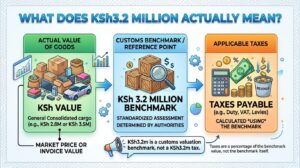
KRA has been clear that KSh3.2 million is not a flat tax or an automatic valuation applied to every container. The Authority describes it as a minimum reference point for general consolidated cargo. Where the actual value of imported goods is higher, the importer is expected to declare that value and pay the applicable taxes. The benchmark is intended to provide customs administration with a more predictable reference point, where consolidation can make it difficult to establish the true value of individual consignments.
Rectifying an Error
The challenge lies with the instrument. KRA notes that the previous KSh2.5 million benchmark had remained unchanged for about six years, despite shifts in economic conditions, import values and the composition of goods entering Kenya. Updating an outdated benchmark is therefore not inherently unreasonable. Leaving it untouched indefinitely could create precisely the valuation gaps that the customs administration is expected to close.
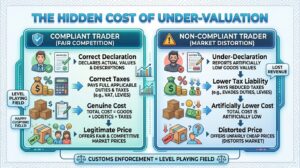
The more difficult question concerns differentiation. A small trader importing relatively low-value goods may reasonably ask why their circumstances should be shaped by a benchmark partly designed to address the behaviour of non-compliant actors. The debate therefore needs to move beyond whether KRA or traders are right. The central issue is whether Kenya’s customs system can distinguish legitimate trade from deliberate evasion.
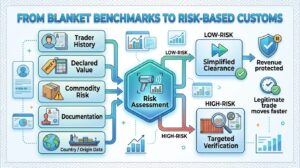
This is where risk-based regulation becomes critical. A trader with a strong history of accurate declarations, proper documentation and consistent compliance presents a different risk profile from an importer repeatedly associated with significant discrepancies. Applying a higher administrative floor across a diverse trading environment can catch bad actors, but it can also impose unnecessary costs on compliant businesses.
Modern customs systems increasingly use trader history, commodity risk, documentation, valuation data, and other indicators to determine where scrutiny is required. Kenya can pursue the same principle more aggressively: simplify clearance for demonstrably compliant traders while directing intensive verification towards high-risk consignments.
Effective Communication for Customs Policy
The controversy also exposes a communication problem. KRA’s clarification that KSh3.2 million is not a flat valuation is technically significant. For a trader facing higher clearance costs, however, the distinction between a “minimum benchmark” and a “minimum taxable value” can become economically meaningless if the practical outcome is an unexpected increase in the cost of importing goods.
Policy communication therefore needs to accompany policy implementation, not follow it. Consultation should also extend beyond announcing the measure. KRA will need to demonstrate that legitimate traders have accessible avenues to challenge valuations that do not reflect their actual consignments. Periodic review should form part of the framework, so the new benchmark does not eventually become another static figure disconnected from market realities.
The broader lesson is uncomfortable but necessary. Kenya cannot afford a customs system riddled with loopholes. It also cannot afford a small-business economy in which unpredictable compliance costs price out legitimate traders. Government needs the revenue, while the economy needs the businesses generating it.
The success of the KSh3.2 million benchmark should therefore not be judged simply by how much additional revenue it generates or how firmly KRA imposes it. The stronger test is whether it makes evasion harder, compliance more predictable and legitimate trade more competitive.
The real KSh3.2 million question is not whether Kenya should close customs loopholes. It is whether it can close them intelligently enough to ensure the compliant do not end up paying for the failures of the non-compliant.